The tidy-looking breaks in many petrified logs are natural fractures, not saw cuts. At Petrified Forest National Park, the wood has become largely quartz. Hard, brittle mineral breaks differently from the flexible wood of a living tree, and geological stress can leave surprisingly clean divisions.
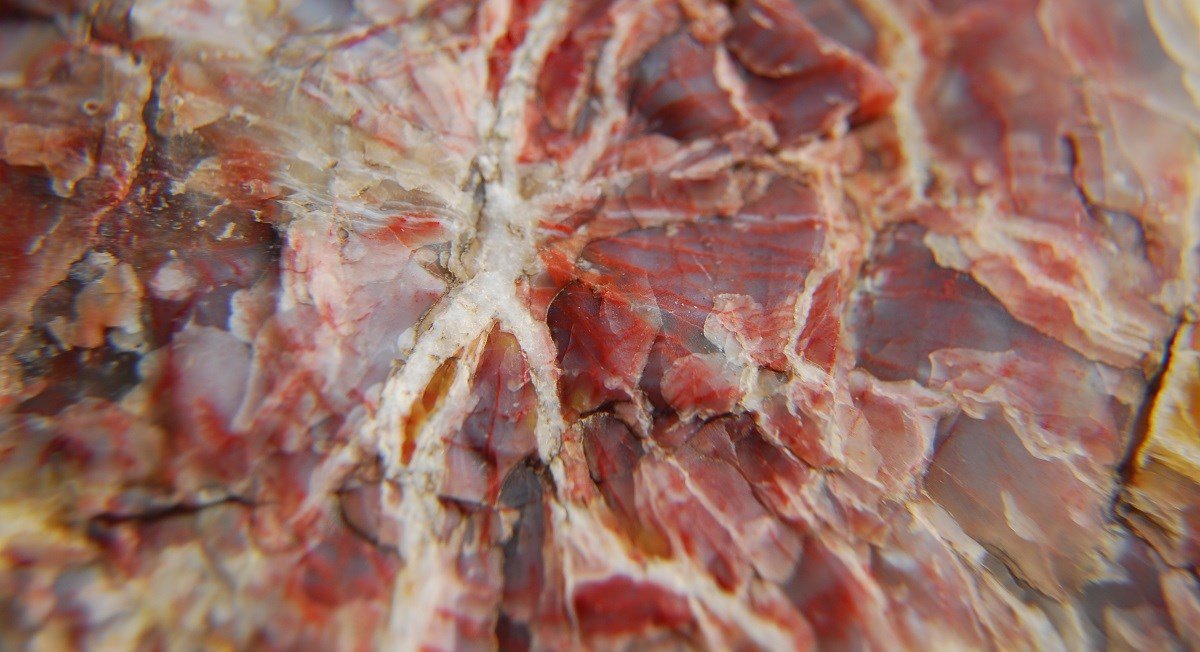
A crystal-filled close-up of petrified wood. Mineral material preserves a very different record from the living tree.
A log is such a familiar shape that it invites a familiar explanation. Someone must have cut it. Then the material refuses to cooperate with the story: the surface sparkles, the colors seem extravagant, and the “wood” is stone.
The close-up photograph here makes the second surprise easier to see. The crystal-filled surface is not what you expect inside a trunk. Before trying to name every color, simply look for the places where light catches an edge.
How a tree becomes a mineral record
The park’s ancient logs were buried in sediment more than 200 million years ago. Burial reduced exposure to oxygen and slowed decay. Mineral-bearing water moved into the wood, and silica associated with volcanic ash helped preserve its structure as organic material broke down.
Two processes help explain fossil preservation. Permineralization fills pores with minerals. Replacement substitutes mineral material for original material that has dissolved away. They can occur together, and they are more precise descriptions than the broad phrase “turned to stone.”
Those distinctions are worth keeping. A fossil is not necessarily a petrified object. A footprint can be a fossil; an impression of a leaf can be one too. The scientific category is larger than the glittering log that happens to be in front of us.
The break belongs to the stone
NPS explains the segmented logs in relation to stress during uplift of the Colorado Plateau. By then, the buried trunks contained hard, brittle quartz. Their fractures can resemble the clean breaks of glass rods. The visual resemblance to a sawed log is real; the proposed saw is the mistake.
The colors introduce another question. In the park’s petrified wood, impurities including iron, carbon and manganese contribute to the range of hues. A colorful patch is a clue to mineral history, not paint left by the tree.
On a future museum visit, try giving a specimen two separate looks. First follow the outline that tells you what the living object was. Then inspect the material that tells you what happened afterward. A trunk can preserve one kind of information in its shape and another in its crystals.
Look again at the crystal-filled surface. A tree fell. Water carried minerals. Rock formed. Much later, the rock broke in a way that makes us imagine a person with a tool.
Keep exploring
Sources and image credit
NPS / Lauren Carter. No claim to original U.S. Government works.