
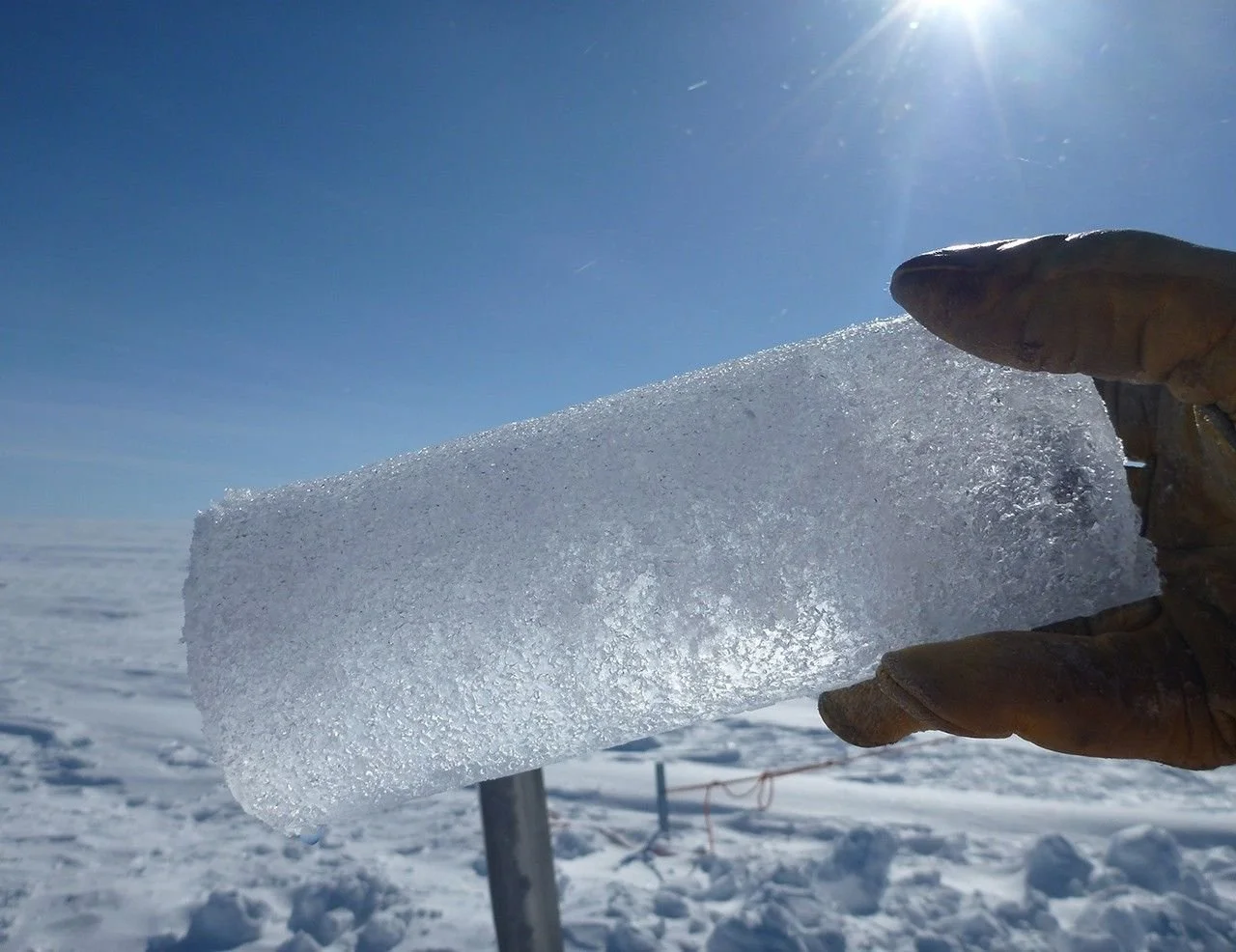
Scientists can study ancient air because some of it is still here, sealed inside ice. As layers of snow accumulate and compact, spaces between the grains eventually close into bubbles. Those pockets preserve atmospheric gases that researchers can extract and measure. [1]
It is an unusually literal time capsule. The ice does not simply resemble the past. Part of the material being investigated actually came from an earlier atmosphere.
Snow makes a surprisingly busy archive
Imagine snow falling, staying put and being covered again. The growing stack presses down on what lies below. Along with trapped air, the resulting ice can preserve dust and other particles. A core drilled from the ice gives researchers a long sample to examine rather than only a look at the surface. [1, 2]
Different parts of that sample answer different questions. Gases in bubbles provide information about atmospheric composition. The chemistry of the ice itself provides clues about past temperature. Particles can supply evidence of events such as volcanic eruptions. These are related records, but they are not interchangeable measurements. [1, 2]
That distinction is worth keeping. A bubble is not a tiny thermometer. Its great talent is preserving some of the air researchers want to understand.
The archive needs a freezer
NASA’s account of ice-core research describes a storage facility in Lakewood, Colorado, where cores are preserved for study. Researchers can request portions of the archive for their work. The practical challenge is almost comically plain: when your historical record is made of ice, keeping it frozen is part of keeping it available. [2]
Think about the care that implies. An ordinary freezer holds something you hope to use next week. This kind of archive holds material that another researcher may approach with a different question or a better way to measure it.
The photograph here shows a real ice core held up to sunlight. It is not a picture of an individual ancient-air bubble, and the photograph alone cannot tell us the sample’s age. It is a good invitation to look more closely at a material we tend to treat as simple.
Water freezes. Snow piles up. Air gets enclosed. With careful sampling and interpretation, those ordinary processes become a way to investigate a world nobody alive could have watched. The astonishing part is not that scientists can imagine the old atmosphere. It is that they can work with pieces of it.
Keep exploring
Meet another ingenious way to measure the world →
Follow another curiosity →
Research references & image credit
NASA’s Goddard Space Flight Center/Ludovic Brucker. Editorial reuse under NASA media guidelines; no endorsement implied.
