The federal Access Pass is available free to US citizens or residents of any age with a medically determined permanent disability that severely limits one or more major life activities. The disability does not have to be rated at 100 percent. Eligibility is based on the federal criteria, not on reaching retirement age.
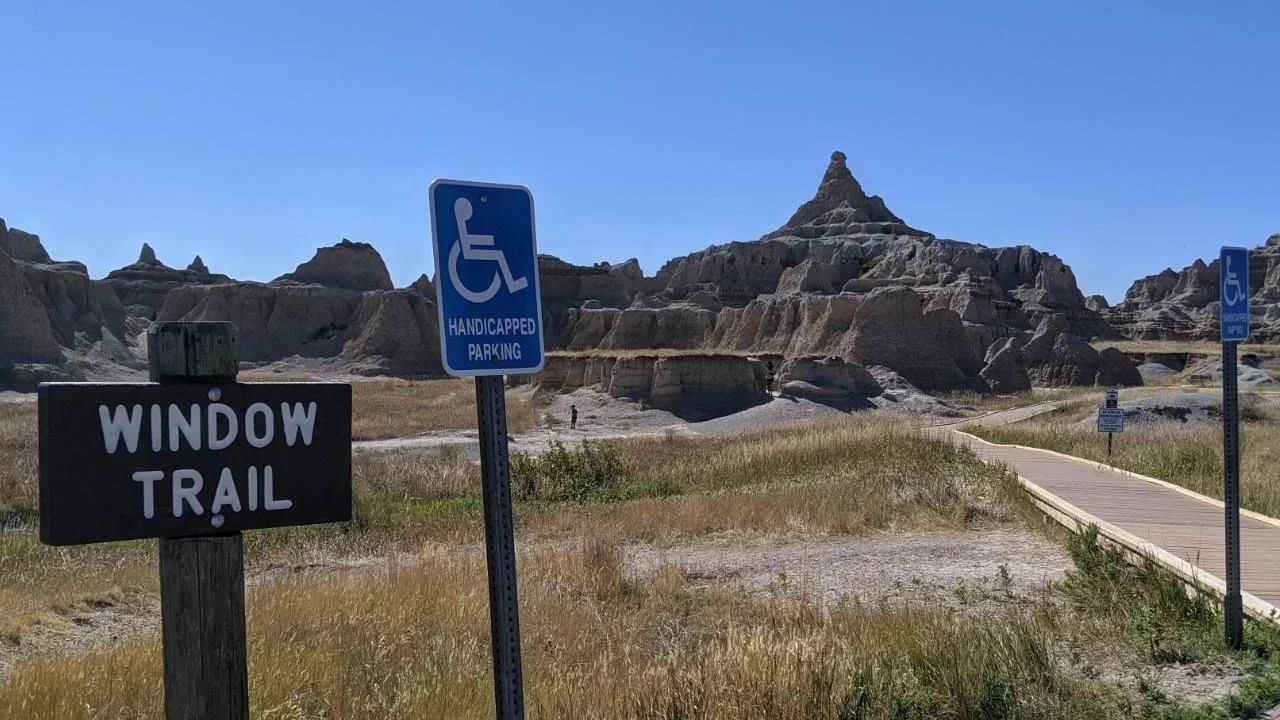
Window Trail at Badlands National Park. Check current access and closures before planning a visit.
That is useful information to know before buying an entrance pass. It is also only the first part of planning a good day outside.
Start with the documents
The National Park Service asks for valid photo identification and qualifying documentation of permanent disability. Its options include a signed physician’s letter describing permanence, substantial daily-life limitations and the nature of those limitations; qualifying federal disability-benefit documentation; or qualifying state vocational-rehabilitation documentation. Read the current official requirements before making a trip to a pickup location.
You can obtain physical passes at participating federal recreation sites. Check the location’s hours and availability first. Mailed orders through the USGS store may take up to three weeks, and an order receipt is not a substitute for the physical pass. Ordering or delivery charges may apply even when the pass itself is free. NPS also links to a digital Access Pass option through Recreation.gov.
The pass and the path answer different questions
America the Beautiful passes cover entrance and standard day-use fees at participating federal recreation lands. They do not turn every part of a visit into a free service. Check the specific site for reservations, tours, camping and other charges. A pass does not replace a timed-entry reservation where one is required.
Then investigate the outing itself. A fee benefit cannot tell you whether a boardwalk is open, whether the restroom meets your needs, or whether the distance from parking is comfortable for you.
The photograph shows the Window Trail at Badlands National Park. NPS describes this short route as accessible, and the boardwalk leads toward a view through the eroded landscape. It is a useful example of the kind of specific place to investigate, rather than assuming every trail in a large park offers the same conditions. Check current conditions before you travel.
Make one useful call
Try asking: “I’m planning a short visit and need to understand the route from parking to the viewpoint. What are the surface, slope, distance and restroom options, and is anything closed?” Add whatever matters to your own visit. The details can be more useful than a broad promise that a destination is accessible.
Choose the view first, check the practical route, and leave room to enjoy it. A beautiful afternoon does not have to include the longest trail on the map.
Keep exploring
Sources and image credit
NPS Photo / Earl Perez-Foust. No claim to original U.S. Government works.