
Those Little Metal Rivets on Your Jeans Had a Job
Before they became a familiar detail, rivets helped solve a working person’s very ordinary problem: trousers that came apart.
There is a good chance you have worn a small piece of engineering without giving it a second thought.
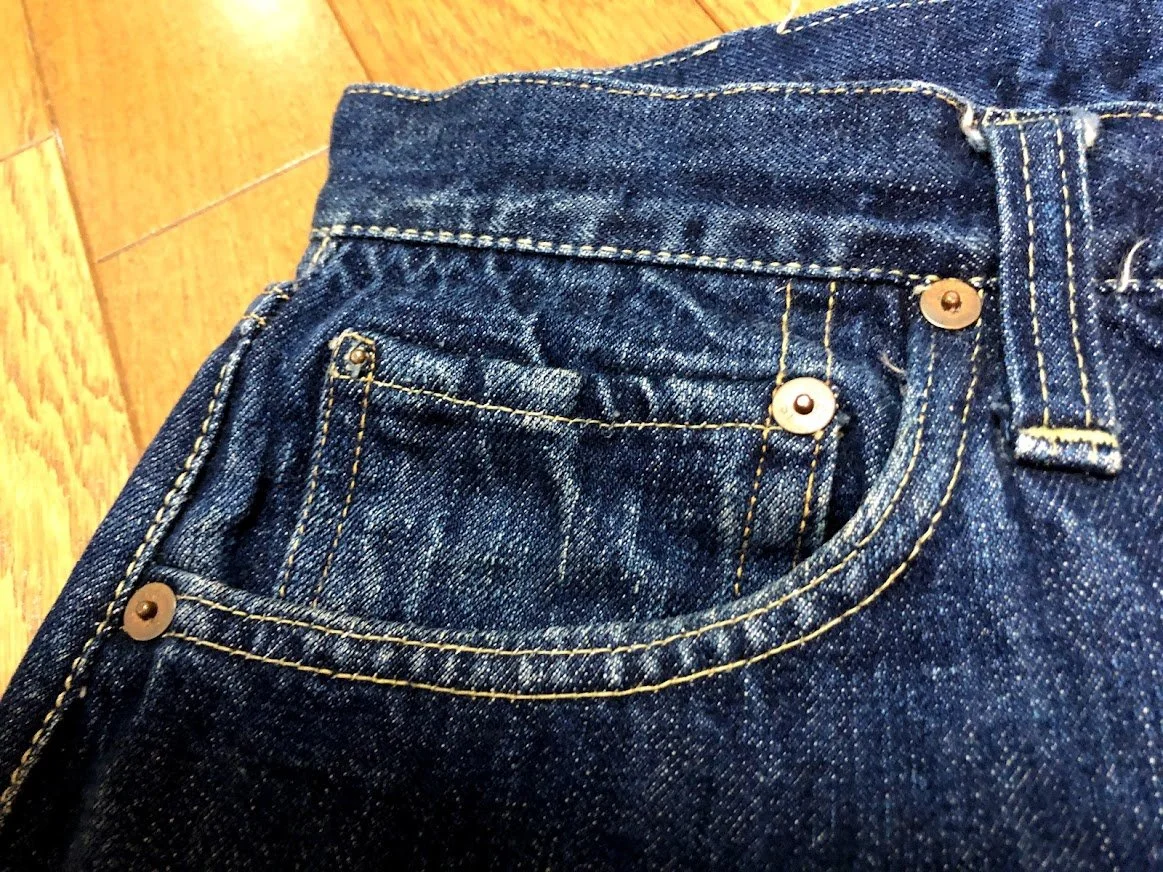
Look at the corners of a pair of riveted jeans. Those little metal fasteners can seem like decoration, as much a part of the look as contrasting thread. Their original assignment was considerably less glamorous: help keep the pants from falling apart.
The idea came from Jacob Davis, a tailor in Reno, Nevada. In a later court deposition, Davis recalled a woman asking him in January 1871 to make strong trousers for her husband. He had been using rivets to fasten straps to horse blankets. Seeing some on his worktable, he thought of putting them at the pockets.
That is a wonderfully specific beginning for a clothing story. Not a runway. Not a forecast about what people would wear a century later. A customer wanted something that would hold up, and a tailor had a useful piece of hardware nearby.
Pocket openings are places where a garment takes strain. Reinforcing their edges with metal gave Davis a way to support the seams at those vulnerable points. The innovation was not the existence of trousers or even denim trousers. It was the reinforcement.
Davis bought cloth from San Francisco merchant Levi Strauss. As demand for his riveted workwear grew, he approached Strauss about becoming a partner in a patent. On May 20, 1873, they received U.S. patent number 139,121 for the pocket-fastening improvement.
The familiar brand name can obscure that collaboration. Strauss helped turn the idea into a business; Davis devised the riveted construction. The company’s own historian has worked to separate that account from later, more colorful origin stories involving a fictional prospector.
The invention also generated a less romantic sequel. Davis and Strauss filed a patent-infringement suit in 1874. They won the following year, receiving $2,000 rather than the $20,000 they had sought. The court records are part of why the practical beginning of the story can still be examined.
A modern pair of jeans may be bought for its fit, wash or shape. The little rivets can disappear into all those choices, noticed only when the light catches them.
But once you know their purpose, they become oddly satisfying to spot. Someone looked at where clothing failed and put the reinforcement there. More than a century later, the solution is still recognizable at the edge of a pocket.
KEEP EXPLORING
Women Once Tied Their Pockets On Separately
https://www.mariecoleexperiences.com/the-mce-journal/women-once-tied-their-pockets-on-separately
SOURCES AND IMAGE CREDITS
U.S. National Archives, Forever in Blue Jeans…and in Court (2010). Patent and Davis’s deposition.
https://prologue.blogs.archives.gov/2010/05/20/forever-in-blue-jeansand-in-court/
Levi Strauss & Co., The History of Denim (2019). Partnership, workwear and patent history.
https://www.levistrauss.com/2019/07/04/the-history-of-denim/
Levi Strauss & Co. historian Tracey Panek, The Truth and Exaggerations of LS&Co. (2024). Distinguishing the invention from later legends.
https://www.levistrauss.com/2024/06/11/truth-and-exaggerations-of-lsco/
Pocket rivets on Levi’s 501XX jeans, photographed in 2022. The image illustrates rivet placement; it is not identified as an original 1873 garment.
Tokunori, via Wikimedia Commons
CC BY-SA 4.0 | https://creativecommons.org/licenses/by-sa/4.0/
https://commons.wikimedia.org/wiki/File:501xx-rivet.jpg
Image unchanged; publication copy renamed.

