Women Once Tied Their Pockets On Separately
These roomy accessories could move from outfit to outfit. Somewhere along the way, we ended up celebrating a dress that can hold a phone.
“It has pockets!” is a perfectly reasonable thing to announce about a dress. It is also a slightly ridiculous victory. We have landed machines on other planets, and a place to put our keys still qualifies as exciting news.
Some women centuries ago had a different arrangement. The pocket was its own accessory.
Tie-on pockets were bags secured around the waist, independent of the outfit. Many had a broad, pear-shaped body and a vertical opening at the front. Openings in dresses and petticoats let the wearer reach through to the pocket underneath. The Victoria and Albert Museum dates their common use in Britain from about 1650 through the end of the 19th century, with some surviving in use later.
These were not necessarily tiny ornamental gestures. The V&A describes surviving examples around 40 centimetres long and 30 centimetres wide, roughly 16 by 12 inches. Some women wore more than one. A pocket could carry possessions and then come off with its contents still inside.
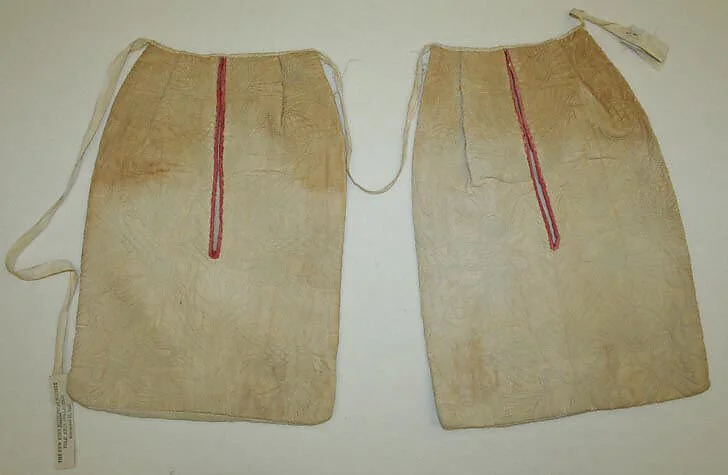
The surviving objects also refuse to be merely practical. The Met’s 18th-century example pictured here is linen and catalogued as probably American. Its pale fabric and contrasting openings make an everyday storage solution worth looking at closely. The museum identifies it as object 1979.346.107.
Other pockets used decorative embroidery. In its modern sewing guide, the V&A explains that historical makers used linen, cotton and silk, sometimes repurposing fabric. The guide draws on pocket shapes published in The Workwoman’s Guide in 1838. It is possible to explore the construction today without pretending there was one standard pocket for every woman or every occasion.
The tempting version of this history is that pockets disappeared and handbags replaced them. The V&A cautions against that tidy sequence: bags and pockets existed together and could serve different purposes. Changing clothing silhouettes also affected how practical tie-on pockets were.
What makes the old arrangement interesting is its independence from the garment. The pocket did not have to be negotiated afresh with every skirt.
A detachable pocket will not suit every modern wardrobe. Still, looking at one makes a familiar shopping frustration feel stranger. The idea of giving women room to carry things is very old. The excitement when we find that room is somehow still current.
JOURNAL SPRITZ
The things we use every day have some very good backstories. Find another in the MCE Journal.
https://www.mariecoleexperiences.com/the-mce-journal
SOURCES AND CREDITS
[1] Victoria and Albert Museum, Women’s tie-on pockets. Dates, construction, size and relationship to bags.
https://www.vam.ac.uk/articles/womens-tie-pockets
[2] The Metropolitan Museum of Art, Pocket, 18th century, probably American. Object 1979.346.107.
https://www.metmuseum.org/art/collection/search/110120
[3] Victoria and Albert Museum, Make your own tie-on pockets. Historical fabrics and 1838 pattern source.
https://www.vam.ac.uk/articles/make-your-own-pockets
An 18th-century linen pocket object, probably American, in The Metropolitan Museum of Art. The collection photograph shows two tied pocket sections.
The Metropolitan Museum of Art, Gift of The New York Historical Society, 1979, object 1979.346.107. Public domain.
https://www.metmuseum.org/art/collection/search/110120
https://www.metmuseum.org/about-the-met/policies-and-documents/open-access