This Frog Hides Its Red Blood Cells Before Going to Sleep
A tiny glassfrog becomes harder to see by storing most of its circulating red blood cells in its liver. Finding out how required scientists to let it sleep.
Going to sleep is an awkward time to be visible to something that might eat you.
The northern glassfrog has an extraordinary response. While it rests, it removes most of the red blood cells from circulation and stores them in its liver. With less red blood showing through its tissues, the little frog becomes more transparent.
This is a real animal, not a proposed special effect.
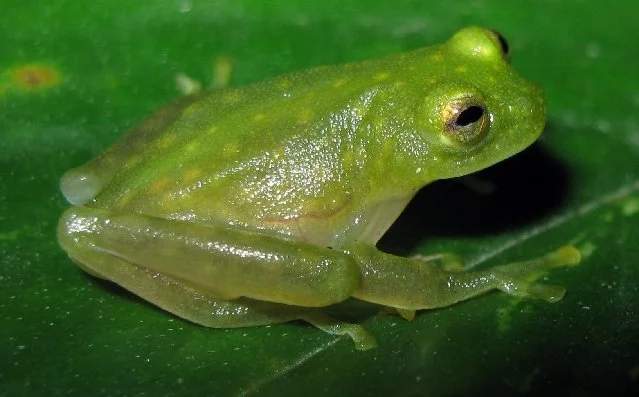
Hyalinobatrachium fleischmanni is only a few centimeters long. Active mainly at night, it rests beneath leaves during the day. Its green coloring helps it blend with vegetation, while transparency reduces how much of its body stands out. The eyes, bones and some internal structures remain visible. It does not become literally invisible.
Blood presents a problem for an animal trying to be see-through. Red blood cells absorb light, making them conspicuous inside otherwise transparent tissue. Having clear skin would not solve that problem by itself. You would still be able to see what was moving underneath.
Researchers Carlos Taboada, Jesse Delia and their collaborators noticed that the cells appeared to disappear when the frogs rested. Discovering where they went was harder than it sounds. Awake, stressed or anesthetized frogs had red blood cells circulating through their bodies. The behavior the scientists wanted to study depended on the animals being peacefully asleep.
The team used photoacoustic imaging, which turns light absorption into a measurable sound signal. A laser illuminated the frog, and an acoustic sensor detected the resulting ultrasonic waves. That let the researchers follow the red blood cells without having to inject a contrast agent.
The answer was striking. During sleep, the frogs stored nearly 90 percent of their circulating red blood cells in the liver. When they became active, cells returned to circulation.
That discovery opened another question. How could the frogs pack so many cells together without producing the sort of dangerous clot researchers might expect? The 2022 study made that an intriguing subject for further investigation, not a ready-made treatment for people.
For now, the frog’s achievement is remarkable enough on its own. We tend to picture camouflage as something happening on the outside: stripes, spots, a color that matches a leaf. This animal also changes what is visible inside its body.
And to catch it doing so, the scientists had to avoid waking it up.
KEEP EXPLORING
Explore the MCE Journal
https://www.mariecoleexperiences.com/the-mce-journal
SOURCES AND IMAGE CREDITS
Duke University, Glassfrogs Hide Red Blood Cells in Their Liver to Become Transparent (2022). Imaging method, findings and open questions.
https://pratt.duke.edu/news/glassfrogs-hide-red-blood-cells-their-liver-become-transparent/
National Science Foundation, Glassfrogs hide red blood cells in their livers to become transparent (2023).
https://www.nsf.gov/news/glassfrogs-hide-red-blood-cells-their-livers-become
Taboada and colleagues, Glassfrogs conceal blood in their liver to maintain transparency, Science (2022), DOI 10.1126/science.abl6620.
https://pubmed.ncbi.nlm.nih.gov/36548427/
Hyalinobatrachium fleischmanni, the species examined in the transparency research. This identification photograph does not show the study’s blood-cell imaging.
Grupo Herpetlogico de Antioquia, Universidad de Antioquia, Museo de Herpetologia, via Wikimedia Commons
CC BY-SA 3.0 | https://creativecommons.org/licenses/by-sa/3.0/
https://commons.wikimedia.org/wiki/File:Hyalinobatrachium_fleischmanni03.jpg
Image unchanged; publication copy renamed.