Smithsonian volunteers turn handwritten pages into searchable records. A useful contribution can begin with a single word.
A handwritten name can survive for a century and still be difficult to find. The page exists. Someone has photographed it. But the words inside that photograph are not necessarily available to a person searching for them.
That is the gap volunteers at the Smithsonian Transcription Center help close. They read digitized material and type what it says, creating text that can be searched and used alongside the original. The work happens online, wherever a volunteer happens to be.
The appealing part is how specific the contribution becomes. You are not being asked to solve the whole problem of preserving history. You are looking closely at a page. Is that a name? Where does this sentence continue? Can you make out a word another reader could not?
The collections include diaries, field notes, ledgers and specimen labels. That last category broadens the picture: transcription can help make scientific records easier to use, as well as letters and accounts of human lives.
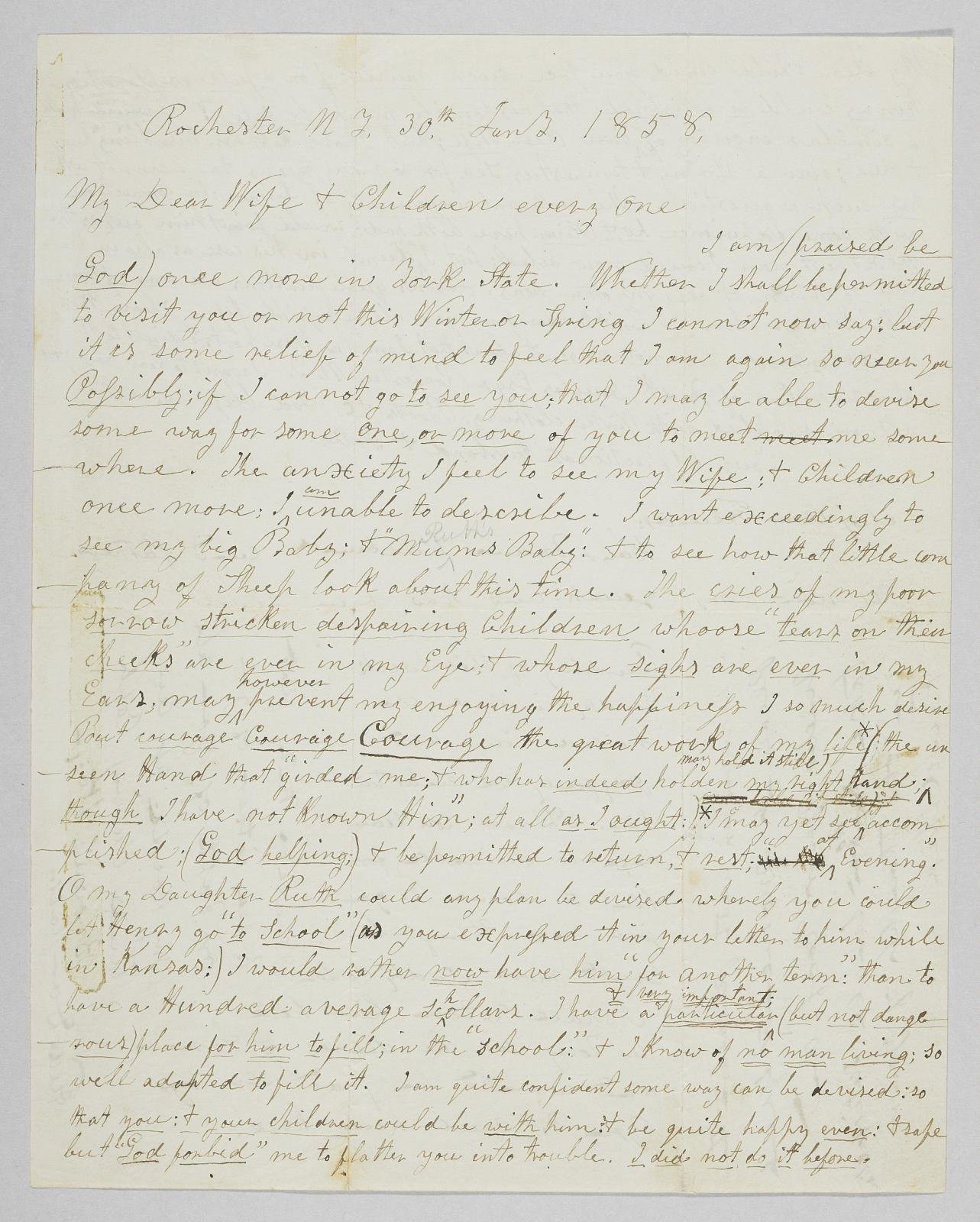
One completed example is a January 30, 1858 letter from John Brown and Frederick Douglass to Brown’s family. The Smithsonian’s record notes that Douglass fitted his contribution onto the reverse in three different directions. A reader has to follow the writing around the page. The record also identifies the letter as transcribed by digital volunteers.
This is careful work, rather than a race to fill a box. The Smithsonian asks participants to follow its transcription guidance and check any special project instructions. It also acknowledges that much of the material is challenging. Comparing completed pages with their transcripts is one suggested way to become familiar with old handwriting.
You can contribute without an account, and there is no minimum quota of words or pages. Reviewing someone else’s completed transcription requires an account. A different volunteer checks a submitted page, with further staff review available for some transcripts.
That gives the work a satisfying shape: an individual contribution becomes part of something other people can use. You do not have to be the person who discovers the whole story. Making one part readable can help the next person ask a better question.
If you are curious, the Smithsonian’s How to Begin page is the place to look. Browse first. See whether the documents interest you. This is volunteer work, not a paid transcription position.
For someone looking for purpose, that is a concrete possibility: use your attention to make another person’s words easier to find.
JOURNAL SPRITZ
A name, a note, a life you had never heard of. Find more discoveries in the MCE Journal.
https://www.mariecoleexperiences.com/the-mce-journal
SOURCES AND CREDITS
[1] Smithsonian Transcription Center, Frequently Asked Questions. Participation, guidelines, difficulty and unpaid status.
https://transcription.si.edu/faqs
[2] Smithsonian, Digital Volunteers. Types of collections and research uses.
https://www.si.edu/es/volunteer/digitalvolunteers
[3] Smithsonian NMAAHC, letter by John Brown and Frederick Douglass, January 30, 1858. Object 2009.26.3.
https://nmaahc.si.edu/object/nmaahc_2009.26.3
[4] Smithsonian Transcription Center, How to Begin. Workflow, review and searchable transcripts.
https://transcription.si.edu/instructions/begin
The front of a January 30, 1858 letter written by John Brown and Frederick Douglass to Brown’s family. Brown wrote this side; Douglass added his words on the reverse. The museum records the letter as transcribed by digital volunteers.
Collection of the Smithsonian National Museum of African American History and Culture, object 2009.26.3. Public domain.