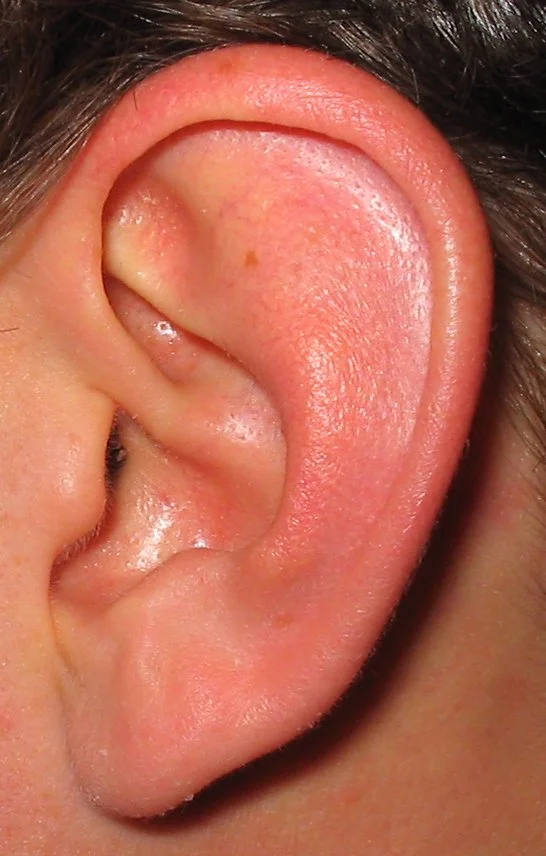
A sensitive microphone can pick up something surprising: sound coming back out of the ear.
In a hearing test, you might expect to listen for a beep and raise your hand. In one kind of test, the person doing the listening is the clinician. The ear supplies the response.
The inner ear can produce faint sounds called otoacoustic emissions. They can be recorded with a sensitive microphone in the ear canal. The organ we think of as a receiver turns out to have an output, too. [E1]
This is possible because hearing is an active process. Within the cochlea, the small, coiled structure in the inner ear, sensory cells respond mechanically to incoming sound. Some of that activity produces sound energy that travels back toward the outside. It is quiet enough to need specialized equipment, rather than a friend leaning closer. [E1]
In a landmark 1978 study, researcher David Kemp examined what happened after brief sounds were played into human ears. He detected a lingering response that was not simply the initial middle-ear response continuing to fade. The findings pointed toward a source within the cochlea. [E2]
Today, otoacoustic emissions are used in newborn hearing screening. A small earpiece plays sounds and measures the returning response. A baby can sleep through it. No raised hand, repeated word or understanding of the instructions is required. [E3]
The measurement has limits. It gives information about parts of the hearing system, not a complete verdict on everything between the ear and the brain. Background noise and middle-ear conditions can affect the result, and this test does not identify hearing-nerve problems. [E4]
Still, the idea is wonderfully unexpected. To learn something about how an ear receives sound, we can listen to what it sends back.
E1: Kemp 2002 review abstract supports cochlear origin, hair-cell motion and microphone measurement. E2: November 1978 original-study abstract supports the delayed response and probable cochlear origin. E3: NIDCD explains the earpiece, sound response and screening during sleep. E4: University of Iowa explains hair-cell assessment and middle-ear limitations. No diagnostic advice or claim of a complete hearing assessment.
E1 | David T. Kemp, Otoacoustic emissions, their origin in cochlear function, and use (2002). Researcher’s account; abstract consulted. | https://pubmed.ncbi.nlm.nih.gov/12324396/
E2 | David T. Kemp, Stimulated acoustic emissions from within the human auditory system (1978), DOI 10.1121/1.382104. Original study; abstract consulted. | https://pubmed.ncbi.nlm.nih.gov/744838/
E3 | NIDCD, Your Baby’s Hearing Screening and Next Steps. Procedure and sleeping during screening. | https://www.nidcd.nih.gov/health/your-babys-hearing-screening-and-next-steps
E4 | University of Iowa, Otoacoustic Emissions. Test limitations. | https://csd.uiowa.edu/clinic/hearing/otoacoustic-emissions