This Metal Can Melt in Your Hand
Gallium looks reassuringly solid. Its melting point has other plans.
A silvery lump of metal is supposed to be dependable. It can scratch, bend or tarnish, but most of us do not expect it to become a puddle because it got a little warm.
Gallium makes that expectation look optimistic.
The element melts at about 29.76°C, or 85.57°F. That is warm enough for an ordinary hot day, and low enough for the warmth of a hand to melt a small piece under suitable conditions. The Royal Society of Chemistry describes the hand-melting effect in its account of the element.
At 20°C, roughly 68°F, gallium is a solid. Give it enough heat to cross its melting point and it becomes liquid metal. The key word is “metal”: it has not dissolved into water, and it has not turned into a different substance. Melting is a change of physical state.
That contrast makes gallium such a good challenge to our everyday picture of materials. We tend to recognize metal by a familiar bundle of features: shine, weight, hardness and resistance to heat. Gallium keeps the metallic appearance while losing its solid shape at a temperature we might call a warm room.
Its discovery has a pleasing twist, too. Dmitri Mendeleev predicted a missing element from a gap in his periodic table before anyone isolated gallium. In 1875, French chemist Paul-Émile Lecoq de Boisbaudran identified it spectroscopically and later obtained the pure metal. The table had pointed toward something real before it had a specimen to show.
Today, gallium is more than a memorable demonstration. Compounds including gallium arsenide and gallium nitride are important semiconductor materials. The Royal Society of Chemistry lists uses in LEDs and electronics. Those compounds have their own properties; a component containing gallium is not a piece of pure gallium waiting to melt in your phone.
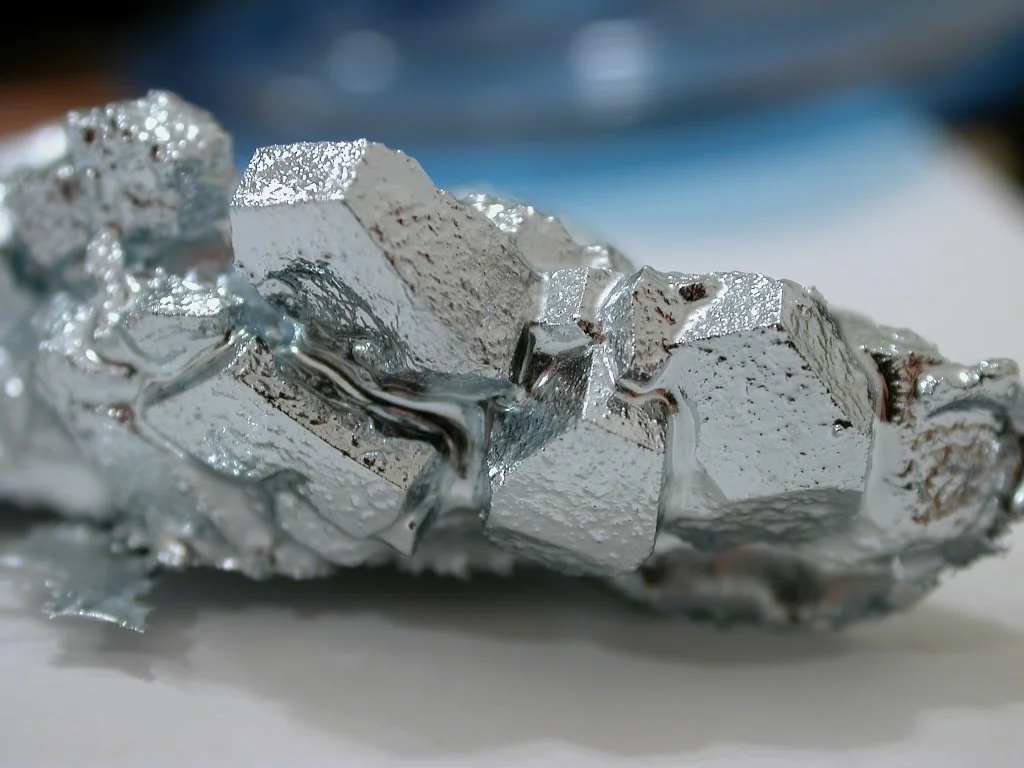
You do not need to handle a sample to appreciate the surprise. A photograph of its crystals and a glance at that melting temperature are enough to unsettle the category.
Solid metal, it turns out, can be a much more temporary arrangement than it looks.
JOURNAL SPRITZ
There is more to ordinary-looking things than their first impression. Explore another discovery in the MCE Journal.
https://www.mariecoleexperiences.com/the-mce-journal
SOURCES AND CREDITS
[1] Royal Society of Chemistry, Gallium. Melting point, physical state and semiconductor compounds.
https://periodic-table.rsc.org/element/31/Gallium
[2] RSC Education, Gallium. Hand-melting demonstration description.
https://edu.rsc.org/elements/gallium/2020009.article
[3] Jefferson Lab, It’s Elemental: Gallium. Prediction, discovery and properties.
https://stem-tools.jlab.org/itselemental/ele031
Solid gallium crystals. This photograph shows the metal’s crystalline form, not a melting demonstration.
Photo: en:user:foobar, via Wikimedia Commons. CC BY-SA 3.0. Reproduced without cropping or retouching.
https://commons.wikimedia.org/wiki/File:Gallium_crystals.jpg