
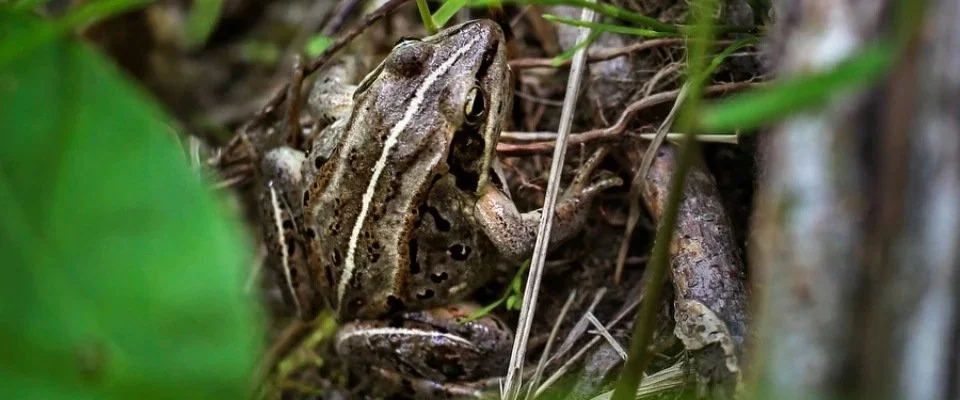
The astonishing part is not simply that a wood frog freezes. It is where the ice is allowed to form.
A wood frog can survive winter with much of its body water frozen. The key distinction is where the ice forms: outside the cells, while protective chemistry helps the cells endure the cold and loss of water. [1, 2, 3]
That is already a remarkable sentence. It becomes stranger when you picture the animal. This is a small woodland frog, tucked into fallen leaves. There is no impressive shell, no obvious winter equipment. Much of the extraordinary preparation is happening inside.
A winter pause with no heartbeat
The National Park Service describes wood frogs sheltering in leaf litter as temperatures fall. Ice forms in spaces around their cells. During the frozen state, breathing and heartbeat stop. When conditions warm, the frogs thaw and resume activity. [1, 2]
“Frozen” can make us imagine every part of the animal becoming one uninterrupted block of ice. That picture misses the biology. The U.S. Fish & Wildlife Service says wood frogs can allow up to two-thirds of their body water to freeze. [3] The remaining distinction between ice and protected cellular contents matters enormously.
The frog has not made freezing harmless everywhere. It has an unusual way of surviving particular freezing conditions.
The liver has work to do first
As freezing begins, the wood frog’s liver converts stored glycogen into glucose. This sugar helps protect cells and limit damage associated with dehydration. NPS describes it as part of the animal’s cryoprotection, the chemistry that helps it tolerate freezing. [2]
There is a lovely change of scale here. From a walking trail, winter may look like a forest going still. Inside one small animal, survival depends on the movement and concentration of molecules.
The details also vary across the species’ range. NPS notes that Alaskan wood frogs tolerate colder conditions and longer periods frozen than wood frogs elsewhere in North America. [2] A striking adaptation is still an adaptation with limits, not a promise that any frog can survive any freezer.
Spring begins near the ground
Sheltering on land gives wood frogs access to an early spring opportunity. As thaw arrives, they can breed in small seasonal pools, including places that will dry later in the year. [1, 2]
The leaves that looked like last season’s leftovers were shelter all along.
This is a story to observe, not an experiment to try on an animal. It also offers no recipe for making human bodies tolerate freezing. The pleasure is in the actual organism and its particular solution.
Somewhere beneath a winter forest’s quiet surface, a very small frog is doing something that still sounds almost impossible when you say it aloud.
Keep exploring
Meet the glassfrog with another remarkable adaptation
Explore the tiny machinery behind goosebumps
Research and further reading
1. NPS Kobuk Valley: Amphibian of the Arctic
3. U.S. Fish & Wildlife Service: Wood Frog
Image credit
NPS Photo/Emily Mesner. Public domain U.S. Government work. No claim to original U.S. Government works.
Image record · Rights statement
Wood frog beside the Kobuk River, photographed alive and unfrozen. This image does not show the frozen state.
