Your Goosebumps Have Tiny Muscles Behind Them
That sudden change in your skin is a coordinated response. Scientists found an unexpected second job for the machinery behind it.
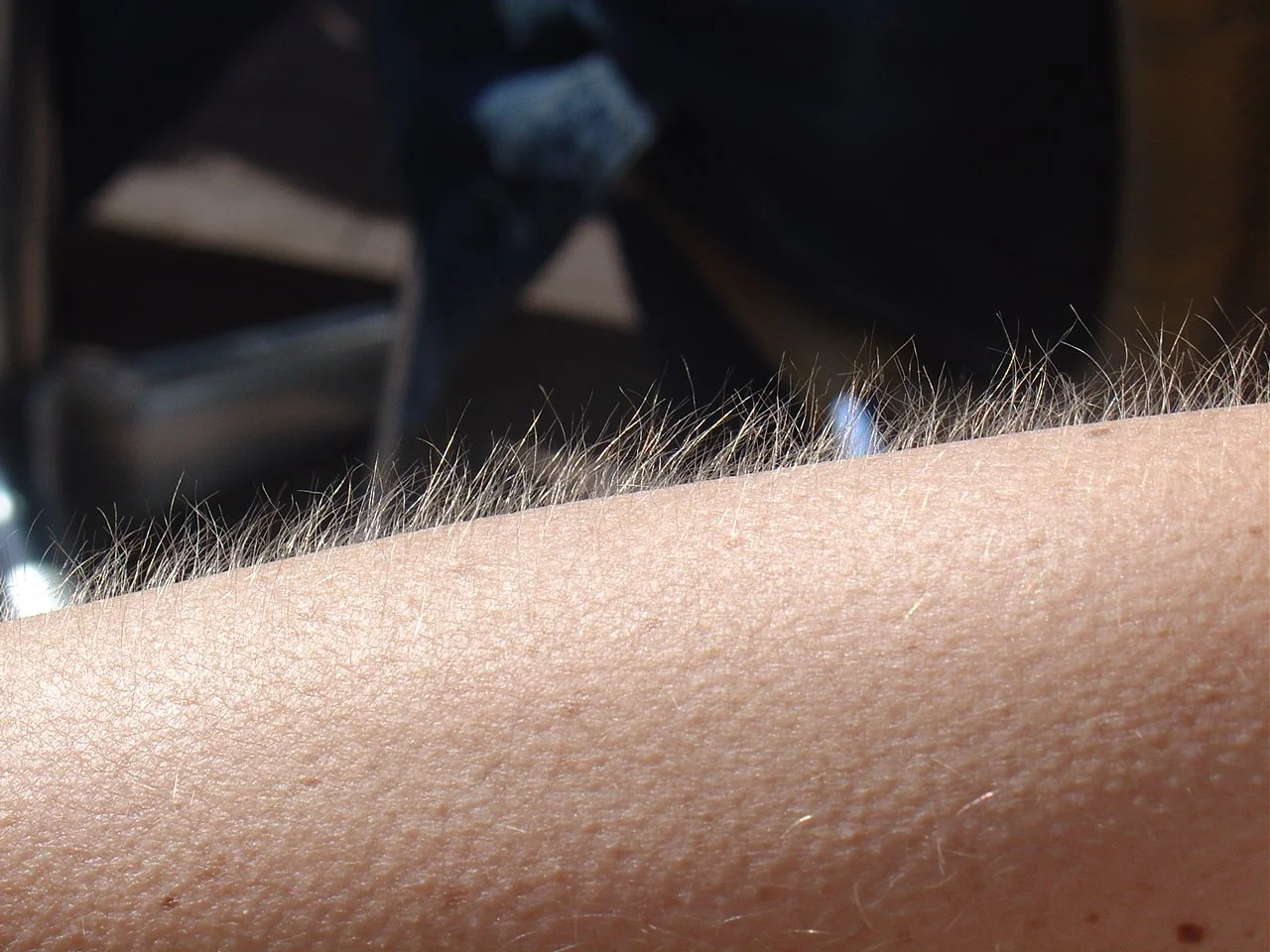
A cool breeze finds your arm, and your skin changes texture. A moment ago it was smooth. Now it looks as if someone has pressed a very small pattern into it.
You did not decide to do that. You probably could not make it happen on command. Yet beneath each little bump, there is actual muscle at work.
The muscles are called arrector pili. Attached to hair follicles, they contract and pull the hairs more upright, producing the familiar raised skin. Nerves deliver the signal. What looks like a surface effect is a tiny coordinated movement.
On an animal with thick fur, raising the hairs helps trap insulating air. Our comparatively sparse body hair makes the same response much less useful as a winter coat. Goosebumps can announce that you are chilly without doing much to solve the situation. A sweater remains the more promising option.
But the machinery beneath those bumps has another story.
In research published in 2020, scientists studying mice found that the sympathetic nerves involved in goosebumps also communicated with stem cells that regenerate hair follicles. Under the microscope, nerve fibers formed close connections around those cells. The little muscle helped maintain the arrangement: when researchers removed it, the nerve connection withdrew.
The response operated on two timescales. Cold could trigger the familiar muscle contraction quickly. Prolonged cold increased nerve signaling and activated the stem cells, supporting new hair growth over time. The same neighborhood of cells was involved in both an immediate response and a longer adjustment.
That finding does not establish that getting goosebumps grows hair in people. The experiments were in mice, and they are not a reason to turn your shower cold in pursuit of a fuller hairline. They reveal something more specific: structures we associate with one obvious function can also help organize other activity beneath the skin.
The bumps are the part we can see. The nerve connections and stem cells are the part we normally miss.
Next time a breeze changes the texture of your arm, there is a rather good answer to what just happened. Tiny muscles moved. Your skin was doing something.
KEEP EXPLORING
Your Ears Make Sounds of Their Own
https://www.mariecoleexperiences.com/the-mce-journal/your-ears-make-sounds-of-their-own
SOURCES AND IMAGE CREDITS
National Institutes of Health, What goosebumps are for (2020).
https://www.nih.gov/news-events/nih-research-matters/what-goosebumps-are
Harvard HSCRB, The real reason behind goosebumps (2020).
https://hscrb.harvard.edu/news/the-real-reason-behind-goosebumps
Shwartz and colleagues, Cell Types Promoting Goosebumps Form a Niche to Regulate Hair Follicle Stem Cells, Cell (2020). Original study record.
https://pubmed.ncbi.nlm.nih.gov/32679029/
Goosebumps photographed after a fresh breeze in Amsterdam in 2005.
EverJean, via Wikimedia Commons
CC BY 2.0 | https://creativecommons.org/licenses/by/2.0/
https://commons.wikimedia.org/wiki/File:Goose_bumps.jpg
Image unchanged; publication copy renamed.