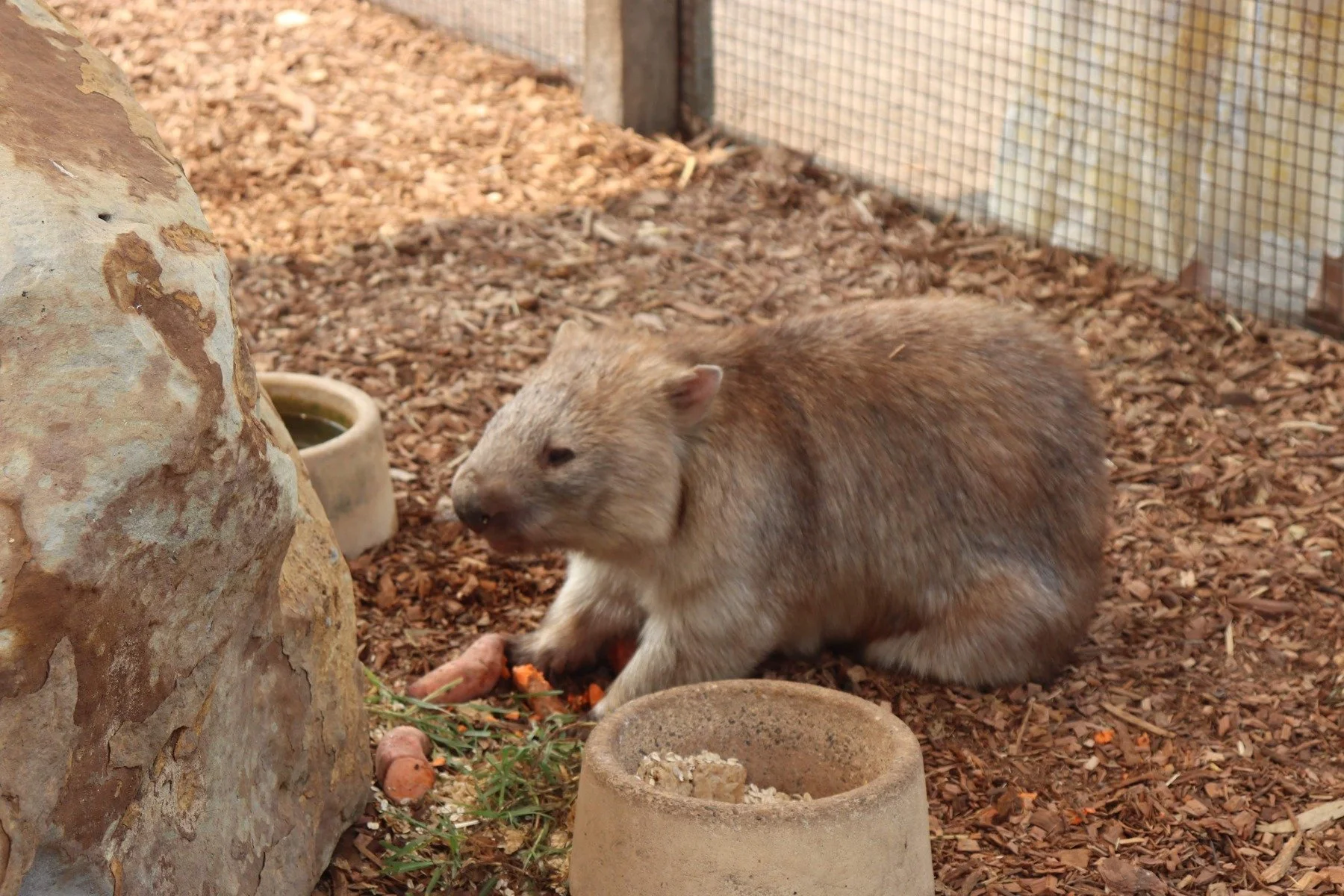
Wombats Make Cubes. Yes, Those Cubes.
The surprising part is not just the shape of their poop. It is how a soft intestine produces corners.
There are many dignified ways to introduce a wombat. Australian marsupial. Burrower. Impressively sturdy animal.
Unfortunately, today we need to talk about the cubes.
The bare-nosed wombat, also called the common wombat, produces distinctly cube-shaped droppings. Once you know that, the obvious question arrives almost immediately: how does an animal do that? A soft digestive tube does not look like equipment for making corners.
Research published in the journal Soft Matter in 2021 investigated that mismatch. The team combined examination of intestinal tissue, mechanical testing and mathematical modelling to study how the shape could emerge. The explanation concerns what happens inside the intestine, rather than a final squeeze through a square opening.
The intestinal wall does not behave the same way all the way around. The researchers found areas with different thicknesses and stiffnesses. Their model used alternating stiff and soft regions and repeated contractions to explore how corners could form. Changing the balance of stiffness changed how square the resulting shapes became.
In plainer terms, a tube need not press equally from every direction. Parts that respond differently to the same cycle of movement can shape what is inside differently. The study offers a mechanical explanation for something that initially sounds like a joke.
Drying matters, too. The University of Tasmania’s account of the research describes water removal and muscular contractions working together in the final part of the colon. This is a process developing along the gut, not the animal moulding finished droppings afterwards.
There is a communication side to the story. Wombats leave droppings at noticeable places in their home range, including rocks and logs. But explaining how cubes form is not the same as proving exactly why the shape evolved. Researcher Scott Carver explicitly noted that the behavioural and evolutionary question still needed more work.
That distinction makes the discovery better. We have a physical explanation to investigate, alongside a question that remains open. The natural world has not finished supplying either.
The wombat, meanwhile, continues its business. It has no idea how much trouble its corners have caused the scientists.
JOURNAL SPRITZ
Nature has range. For another unexpected discovery, visit the MCE Journal.
https://www.mariecoleexperiences.com/the-mce-journal
SOURCES AND CREDITS
[1] Yang and colleagues, Intestines of non-uniform stiffness mold the corners of wombat feces, Soft Matter (2021). Abstract and publication record.
https://pubmed.ncbi.nlm.nih.gov/33289747/
[2] University of Tasmania, Scientists get to the bottom of wombat cubed poo mystery. Researchers’ explanation and open evolutionary question.
A common wombat photographed at Hunter Valley Zoo in December 2019. This is a photograph of the species, not an animal identified as part of the intestinal study.
Photo: Xavier Lahey, via Wikimedia Commons. CC BY-SA 4.0. Resized without cropping or retouching.