We Left Reflectors on the Moon. Scientists Still Use Them.
A brief flash of laser light can make the round trip in about two and a half seconds.
Somewhere on the Moon, an object left by astronauts can still return a signal to Earth. It does not need to compose a message. It only needs to send light back where it came from.
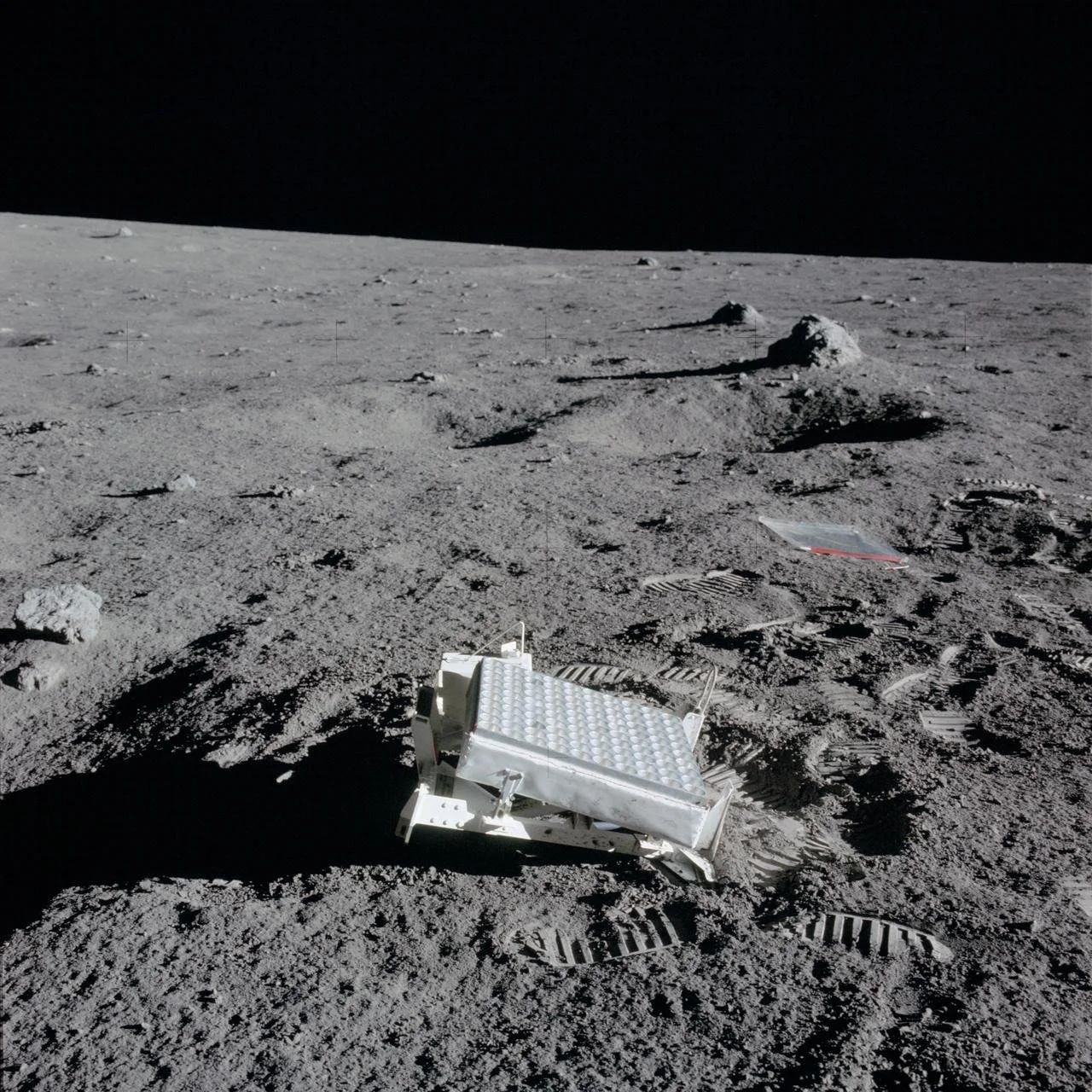
The object is a retroreflector. Apollo astronauts left arrays of these special reflectors on the lunar surface, and observatories on Earth have used them to measure the distance to the Moon. The experiment is wonderfully direct: send a laser pulse, detect the returning light and time the journey.
## A question that made it to the Moon
In 1962, graduate student James Faller put a proposal for a lunar reflector in front of his adviser, physicist Robert Dicke. Seven years later, Neil Armstrong and Buzz Aldrin placed an array based on Faller’s design at Tranquility Base. It held 100 corner-cube prism reflectors in a panel about 18 inches across.
The shape matters. An ordinary mirror can send a beam off in another direction. A corner-cube reflector sends incoming light back toward its source. That makes it useful when the person doing the measuring is on another world.
On August 1, 1969, less than two weeks after the moonwalk, a laser pulse from California’s Lick Observatory successfully reached the array. The return journey took about 2.5 seconds. Because that time covers both directions, researchers divide the light’s total travel distance by two.
## The tiny change hiding in a very long distance
Repeating the measurement over decades revealed that the Moon is moving away from Earth by about 3.8 centimeters, or 1.5 inches, a year. That gradual separation results from gravitational interactions between Earth and the Moon.
The hard part is collecting the returning light. The beam spreads out during the journey, and Earth’s atmosphere scatters it. NASA has also investigated why aging lunar panels return weaker signals than expected, with dust among the possible explanations.
There is something especially satisfying about this experiment. The hardware is on the Moon, but its value comes from people continuing to ask the same precise question over many years: how far away are you now?
SOURCES
[1] NASA: Laser Beams Reflected Between Earth and Moon Boost Science, August 10, 2020
https://www.nasa.gov/missions/lro/laser-beams-reflected-between-earth-and-moon-boost-science/
[2] NIST: To the Moon and Back … in 2.5 Seconds
https://www.nist.gov/history/moon-and-back-25-seconds
IMAGE CREDIT
NASA. U.S. government image; used for editorial and educational purposes without implying endorsement.