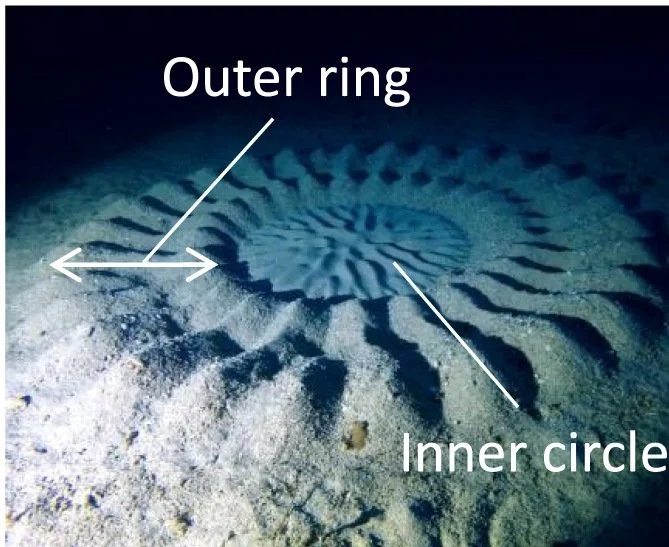
The patterned circles on the seabed are courtship structures, made one small movement at a time.
Imagine finding a carefully patterned circle on the ocean floor. Ridges radiate around its edge. Finer markings fill the center. It looks deliberate, but the maker is nowhere in sight.
Off Japan’s Amami-Oshima Island, divers encountered just such structures. A 2013 research paper describes circles roughly two meters across and the small male pufferfish observed constructing them. The nest is more than six feet wide. Its builder is only a few inches long. [N1]
The fish works close to the sand, excavating with its fins and body. In the observations reported in that study, construction took seven to nine days. Near completion, males also placed shell and coral fragments on the ridges. Females visited the finished nests, and eggs were released in the central area during spawning. [N1]
It is tempting to call the fish an artist. The research establishes something more specific: this elaborate construction is part of reproduction. Our pleasure in its symmetry is not evidence that the fish shares our idea of beauty.
There is another question hiding inside the spectacle. How does such a small animal make something so large and regular?
A later study, published in 2018, analyzed the movements used to build the outer ring. The researchers found that repeated, largely straight excavations, generally beginning at lower positions in the sand, could help explain the emerging pattern. A computer simulation based on the observed behavior reproduced a similar ring. [N2]
That does not mean every detail of nest-building has been explained. The study focused on the outer ring, and a simulation is a way to test an explanation, not a view inside a fish’s mind. But it offers a remarkable possibility: a complicated form can emerge from repeated local actions without requiring the builder to survey the whole design. [N2]
The finished nest invites a wide photograph. The more absorbing view may be the close one: a small fish returning to the sand, making another pass.
Then pull back and look at what it has built.
SOURCES AND CREDITS
N1: Kawase, Okata and Ito, “Role of Huge Geometric Circular Structures in the Reproduction of a Marine Pufferfish,” Scientific Reports 3, 2106 (2013). DOI: 10.1038/srep02106. Field observations, scale, building time, decoration and spawning.
https://pmc.ncbi.nlm.nih.gov/articles/PMC3696902/
N2: Mizuuchi et al., “Simple rules for construction of a geometric nest structure by pufferfish,” Scientific Reports 8, 12366 (2018). DOI: 10.1038/s41598-018-30857-0. Outer-ring analysis and simulation, not a complete account of cognition.
https://pmc.ncbi.nlm.nih.gov/articles/PMC6098008/
A pufferfish nest near completion, photographed for the 2018 study. The researchers’ labels identify its outer ring and inner circle. Detail from Figure 1A.
Image: Mizuuchi et al., Scientific Reports 8, 12366 (2018), Figure 1A. CC BY 4.0. Panel A photo isolated at pixel box (94,97,763,644); annotations retained. JPEG conversion. No generated content.