A small purchase in Ohio introduced a different way for a store to recognize what it was selling.
If you were staging the arrival of a new technology, you might choose an impressive first object. Something expensive. Something that photographs well. Something with a little ceremony attached.
The first supermarket barcode purchase was chewing gum.
On June 26, 1974, a Marsh supermarket in Troy, Ohio, put a new scanning system into service. A package of Wrigley’s gum became the first purchase scanned using the new UPC system. The Smithsonian’s National Museum of American History holds one of the original ten scanners installed at the store. [T1]
The machine did not look at the package and recognize gum the way a person would. A laser beam reflected from the printed code, a detector picked up the signal, and a computerized register matched it with information in a database. The package had become something the checkout could identify by reading a pattern. [T1]
That is the useful trick behind the stripes. They let an object carry an identifier that a machine can read. The computer can then connect the identifier with the information it needs. The visual pattern and the stored record do different jobs.
The design had taken time to arrive. The National Science Foundation traces an early barcode concept to a circular bull’s-eye in 1948, intended to work from different orientations. The familiar rectangular UPC followed in the 1970s. A workable checkout system needed more than an ingenious mark: it also needed scanners and computing capable of using it. [T2]
There is one delightful museum correction to this story. Despite accounts that have placed the famous gum in the Smithsonian, the museum says it never received that package. It remained with Clyde Dawson of Marsh Supermarkets. The scanner is in the collection; the gum is not. [T1]
The scene is wonderfully ordinary: a shopper, a small purchase, a checkout. Nothing about the item announces that it belongs in a technology story.
Which makes the ending rather good. A machine read the stripes, a store recognized the product, and someone bought gum.
SOURCES AND CREDITS
T1: Smithsonian National Museum of American History, “Supermarket Scanner,” catalog 1994.0180.01. Date, place, equipment, operation and correction concerning the gum’s whereabouts.
https://www.si.edu/object/supermarket-scanner%3Anmah_892778
T2: U.S. National Science Foundation, “Lines of History: Revolutionizing the Barcode.” Early circular design, rectangular UPC and enabling technology.
https://www.nsf.gov/impacts/barcode
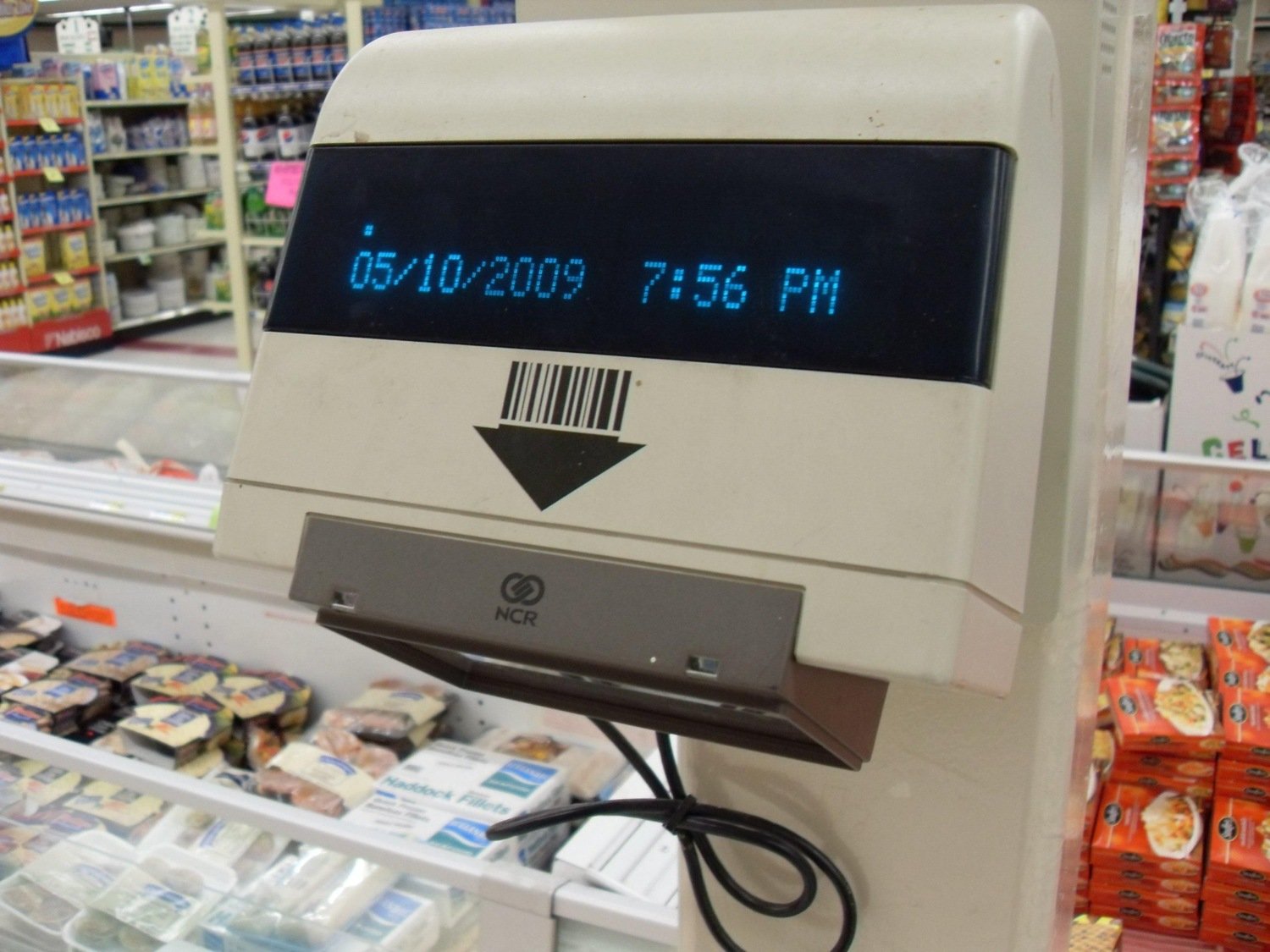
A later supermarket price-checking scanner, shown to illustrate the technology. This is not one of the scanners installed at Marsh in 1974.
Image: Luke. Public-domain dedication. Resized and JPEG re-encoded; full composition retained.
https://commons.wikimedia.org/wiki/File:An_old_price_scanner_at_a_supermarket.jpg
https://commons.wikimedia.org/wiki/File:An_old_price_scanner_at_a_supermarket.jpg