
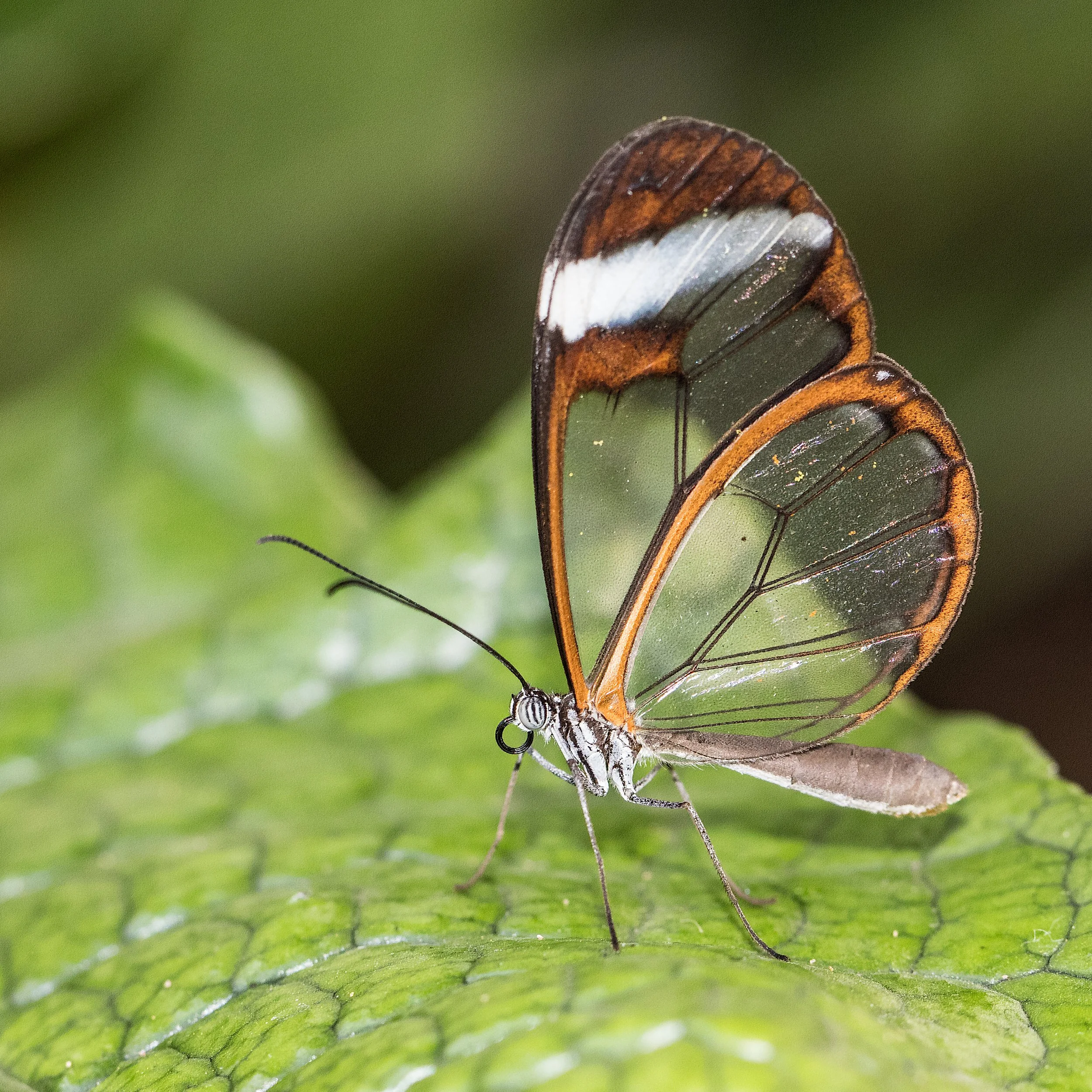
This Butterfly Has Its Own Anti-Glare Coating
Transparent wings take more than leaving the color out.
You can see through a clean window and still catch a bright reflection in it. Transparency does not automatically make something hard to notice.
That is what makes the glasswing butterfly, Greta oto, more interesting than a butterfly with clear patches. Its wings also have microscopic structures that reduce the light bouncing off their surface. [G1]
Start with the scales. Many butterfly wings are covered in overlapping scales that contribute to their colors. In the glasswing’s transparent regions, scales are sparser and shaped differently, including slender, bristle-like forms. More of the underlying wing membrane is exposed. A 2021 study followed these differences as the wings developed. [G1, G2]
But exposing a clear membrane leaves the window problem: light can still reflect from it.
The researchers found two layers of tiny surface structures. Above a lower layer of small bumps sits an irregular array of wax-based pillars. These are not visible as individual towers to an unaided eye, but their arrangement helps reduce reflection. The apparently empty part of the wing has a remarkably elaborate surface. [G1]
To investigate what the waxy layer contributed, the team removed it with a chemical treatment and measured the wing’s reflectivity. More light reflected after the treatment. The experiment helped show that the wax structures were doing optical work, not merely sitting there. [G1, G2]
This is not complete invisibility. The butterfly still has a body, veins and colored wing borders. Nor does every clear-winged insect achieve transparency in exactly the same way. The discovery concerns a particular species and the structures that help its clear regions stay clear. [G1]
A photograph shows the first surprise: you can see the background through a butterfly’s wings. A microscope reveals the second.
The parts that seem to be missing are full of detail.
Source and Interesting Reading
G1: Pomerantz et al., Journal of Experimental Biology, May 28, 2021, DOI 10.1242/jeb.237917: Figures 2–4 support altered scale density and shape; Figures 5–6 support the wax-based nanopillars, lower structures, chemical treatment and increased reflection. Optical experiment used three individuals per treatment and technical replicates; no population-wide effect size claimed. G2: MBL, June 10, 2021, independently confirms the research-team context. No claim of invisibility or universal clearwing mechanism. Window comparison and final sentence are editorial interpretation.
G1 | Pomerantz et al., Developmental, cellular and biochemical basis of transparency in clearwing butterflies, Journal of Experimental Biology (2021), DOI 10.1242/jeb.237917. Full primary paper, especially Figures 2–6. | https://pmc.ncbi.nlm.nih.gov/articles/PMC8340268/
G2 | Marine Biological Laboratory, Seeing the Invisible: How Butterflies Make Transparent Wings (June 10, 2021). Research team’s institutional account. | https://www.mbl.edu/news/seeing-invisible-how-butterflies-make-transparent-wings
