Scientists have strong evidence that Europa, a moon of Jupiter, contains a salty ocean beneath its icy surface. One crucial clue came from Galileo’s measurements of magnetic fields around the moon. The observations fit an electrically conducting layer below the ice, with salty liquid water the leading explanation. [1]
An ocean is usually a fairly conspicuous thing. It stretches to a horizon, rearranges your hair and gets into your shoes. Europa’s suspected ocean has offered none of those courtesies. Its water is hidden, so investigators needed a way to ask a question through the lid.
The moon answered in magnetism
Jupiter supplies a surrounding magnetic field that changes as experienced by Europa. A conducting layer can respond by producing an induced magnetic field of its own. Galileo carried a magnetometer to measure the fields it encountered. The shape and changing direction of Europa’s response became evidence about what could be inside. [1, 4]
Picture the investigative problem rather than an underwater view: two explanations can fit an early observation. One says the moon has a permanent internal magnetic field. Another says its field is a response to the changing field around it. A useful next observation is one that makes those explanations predict different results.
A particularly revealing flyby
On January 3, 2000, Galileo passed Europa while the external magnetic field had an orientation not examined during earlier close encounters. Margaret Kivelson and colleagues reported that the resulting measurements helped distinguish an induced field from a permanent one. The changes matched what would be expected from a current-carrying outer layer, such as a global liquid ocean. [2]
That is the delicious part of the story. The spacecraft did not need to see a wave. It needed the hidden interior to behave differently under a changed magnetic condition. A measurement in the space around a moon could carry information about material below its surface.
The team’s paper described a stronger case for a subsurface ocean. That wording matters. It records an inference strengthened by evidence, not a claim that a camera looked under the ice.
What the beautiful picture actually shows
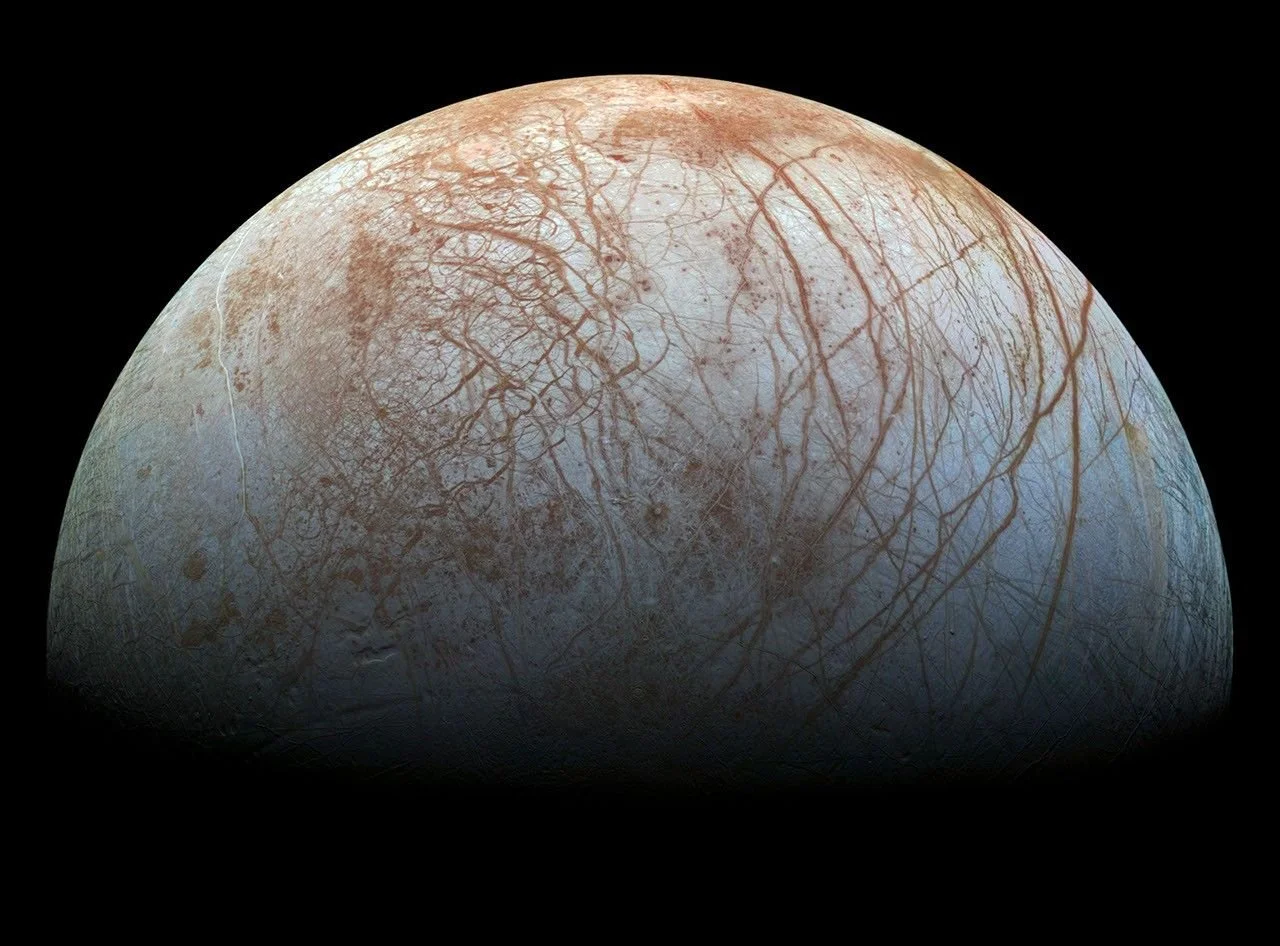
The Galileo mosaic accompanying this story is a processed view of Europa’s exterior, assembled from spacecraft observations. Its lines and disrupted areas belong to the surface geology. The color treatment approximates a human-eye view, while gaps were assigned color from nearby comparable terrain. [3]
Look at those marks, then ask a separate question: what observation would tell us about what lies below them? Keeping the image and the magnetic evidence separate makes both more interesting. One invites your eye across a landscape. The other asks your imagination to follow a physical measurement into a place the eye cannot reach.
An answer with questions still attached
NASA describes the salty ocean as the most likely explanation for the magnetic signature and identifies further measurements as a way to test and characterize it. [1] The evidence does not give us a photograph of a seafloor, a complete map of the water or a discovery of living things.
You can enjoy the scale of the possibility without decorating it with inhabitants. For now, an icy moon and a revealing magnetic response are quite enough to stop over. Somewhere beneath that complicated surface may be an ocean, and one of its clearest introductions came through an instrument that never got wet.
Keep exploring
Meet the Moon experiment still in use →Follow another question in the Curiosity Room →
Research references & image credit
Kivelson and colleagues: Galileo magnetometer measurements, Science, 2000
JPL: Galileo Findings Boost Idea of Other-Worldly Ocean, January 10, 2000
NASA/JPL-Caltech/SETI Institute. PIA19048. Used for editorial explanation under NASA media guidance and JPL image-use policy; no endorsement implied.