The Mail Once Took a Shortcut Under New York
Long before an inbox could refresh, letters could cross part of the city inside a tube.
Imagine dropping a letter into the post and then trying to follow it. You watch the street for a wagon. Meanwhile, your envelope has gone underground.
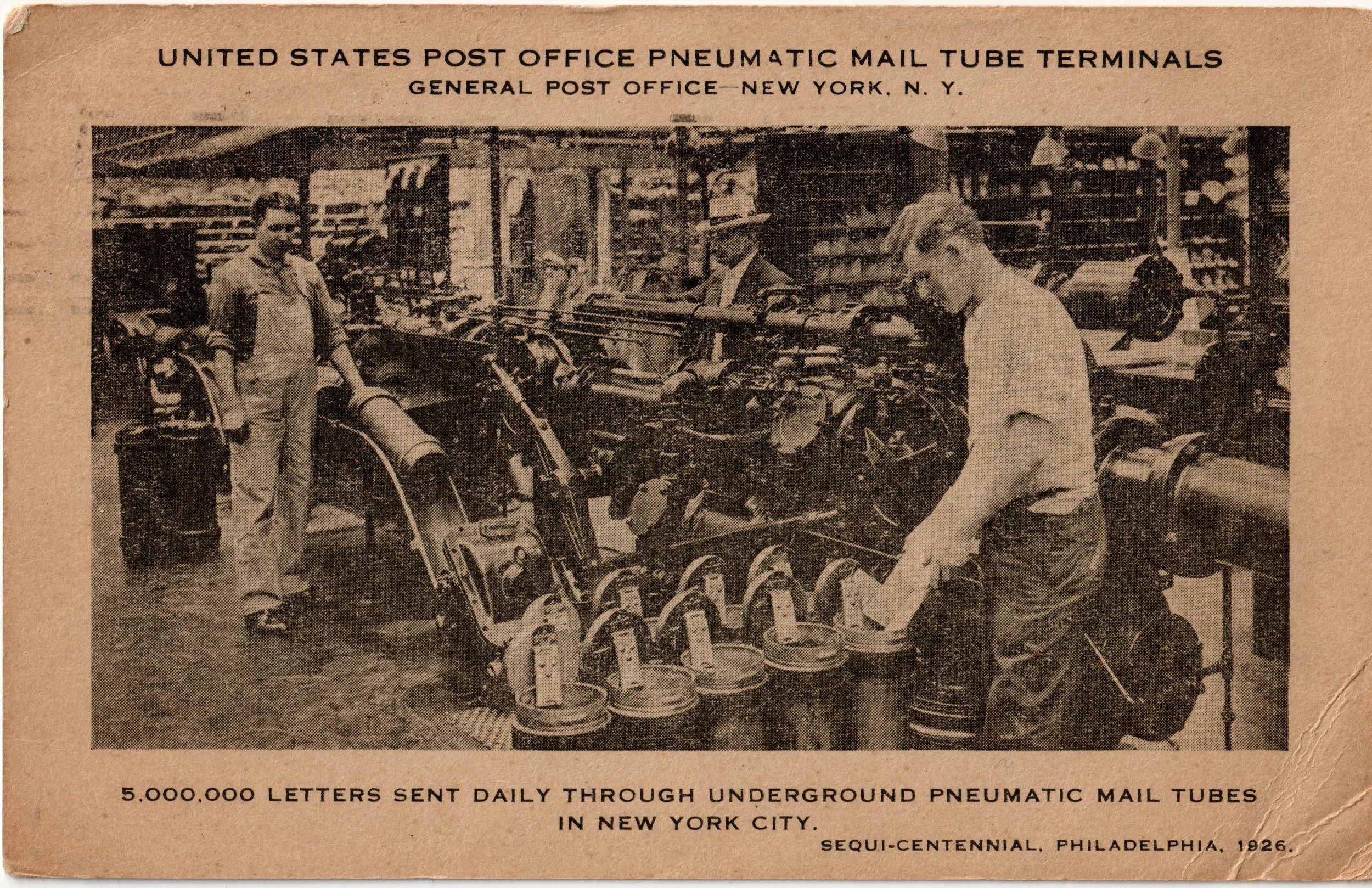
Beginning in the 1890s, American cities used pneumatic tubes to move mail between postal facilities. Workers loaded letters into cylindrical carriers, and compressed air propelled them through pipes. Philadelphia introduced a system in 1893; New York followed in 1897. These were real envelopes taking a physical shortcut beneath the traffic. [M1, M2]
The National Postal Museum preserves a canister used in New York in the late 1940s and early 1950s. According to its collection record, that carrier could hold as many as 600 letters and travel at about 35 miles an hour. Those figures describe the museum’s example, not every tube system ever built. [M2]
The advantage was more than a satisfying whoosh. The museum describes a New York route that took 40 minutes by mail wagon and seven minutes by tube. A letter still needed sorting and delivery, but one stretch of its journey could happen without waiting for the street above to clear. [M3]
New York’s network eventually contained roughly 27 miles of tubes. It is a lovely thing to add to your mental picture of the city: people walking overhead, correspondence moving through its own narrow routes below. [M1]
The system had practical limits. Pipes connected fixed places, and building and maintaining the networks cost money. As automobiles became an alternative for moving the mail, postal tube systems were phased out. Speed alone did not settle the question of what was worth operating. [M1]
The surviving canister makes the whole arrangement wonderfully tangible. Someone opened it, packed in ordinary letters and sent it away. Somewhere else, another person opened it again.
Between those two pairs of hands, the mail had briefly outrun the street.
Source and Interesting Reading
M1: USPS, February 16, 2024, updated December 29, 2025, supports Philadelphia 1893, compressed-air carriers, approximate 27-mile network and operating costs. M2: National Postal Museum indexed object record npm_0.269514.1 supports New York 1897, the surviving late-1940s/early-1950s object, up to 600 letters and about 35 mph. M3: Museum indexed exhibition text supports the 40-minute wagon versus seven-minute tube comparison; not asserted for all routes. Direct museum pages rejected retrieval, so indexed authoritative text was checked separately. Imagined opening is explicitly hypothetical. Brooklyn Bridge segment was above ground; copy describes only part of the journey.
M1 | Donna Peremes, A pipe dream realized, USPS (2024; updated 2025). Mechanism, Philadelphia year, network length and costs. | https://news.usps.com/2024/02/16/a-pipe-dream-realized/
M2 | National Postal Museum, Pneumatic tube canister, object 0.269514.1. New York start year and this specific object’s capacity and speed. Corrected URL; indexed museum object text rechecked October 29, 2026. | https://postalmuseum.si.edu/object/npm_0.269514.1
M3 | National Postal Museum, Pneumatic Tube Mail. Route comparison; indexed museum text consulted because direct page retrieval was blocked. | https://postalmuseum.si.edu/exhibition/customers-and-communities-serving-the-cities-city-free-delivery/pneumatic-tube-mail