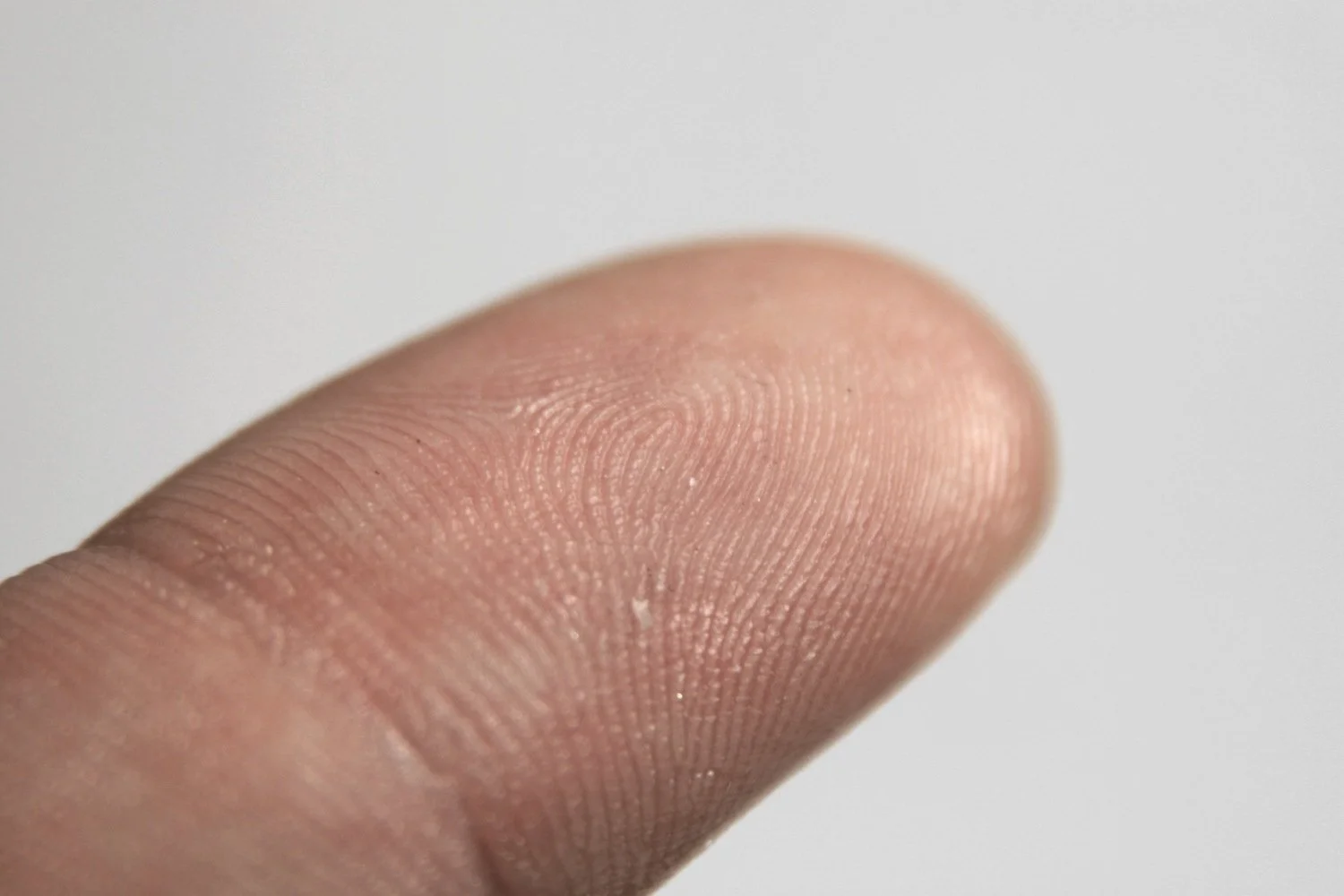
The tiny ridges on your hands formed through a process more dynamic than a miniature stamp.
Look at the pad of one finger. The ridges are so orderly that it is easy to imagine them arriving as a finished design: this curve here, that loop there, every line assigned its place.
A study published in Cell in 2023 describes something much livelier. Before birth, fingerprint ridges develop in waves that spread from different starting points on a growing finger. Where those waves begin and how they meet help determine the pattern. [B1]
These are waves of biological pattern formation, not liquid sloshing around beneath the skin. Chemical signals help organize where cells grow to form ridges. The researchers identified interacting signaling pathways, including WNT, EDAR and BMP, that help produce the repeating bands. [B1]
The names are less important than the arrangement: neighboring cells are interacting while the pattern takes shape. A fingerprint does not require a separate instruction for every bend in every ridge.
The team’s modeling suggested that changing the position, timing and angle of the starting waves could produce different patterns. The anatomy of the developing finger also matters. There is a common process, but many possible outcomes. [B1]
That is a satisfying answer to a question we rarely ask. We tend to encounter fingerprints after they are finished, when a phone wants to recognize a thumb or a glass needs wiping. The study asks how the surface got that way in the first place.
It also changes what there is to notice. Follow a ridge toward a curve. Look at the neighboring lines bending around it. The finished pattern is still, but the explanation involves growth, signals and waves meeting.
You can spend years using a fingerprint as proof of who you are without once wondering how your body made it.
The little swirl was there long before you had anything to unlock.
SOURCES AND CREDITS
B1: Glover et al., “The developmental basis of fingerprint pattern formation and variation,” Cell 186, 940–956.e20 (2023). DOI: 10.1016/j.cell.2023.01.015. Mechanism and modeling; publication date March 2, 2023, online February 9.
https://www.sciencedirect.com/science/article/pii/S0092867423000454
B2: University of Edinburgh, Institute of Genetics and Cancer, “New study reveals how unique human fingerprint patterns develop,” March 1, 2023. Institutional explanation checked against the paper.
The finished pattern: a close photograph of fingertip ridges. This shows the adult surface, not the prenatal waves that formed it.
Image: Zephyris. CC BY-SA 3.0. Resized and JPEG re-encoded; full composition retained.