
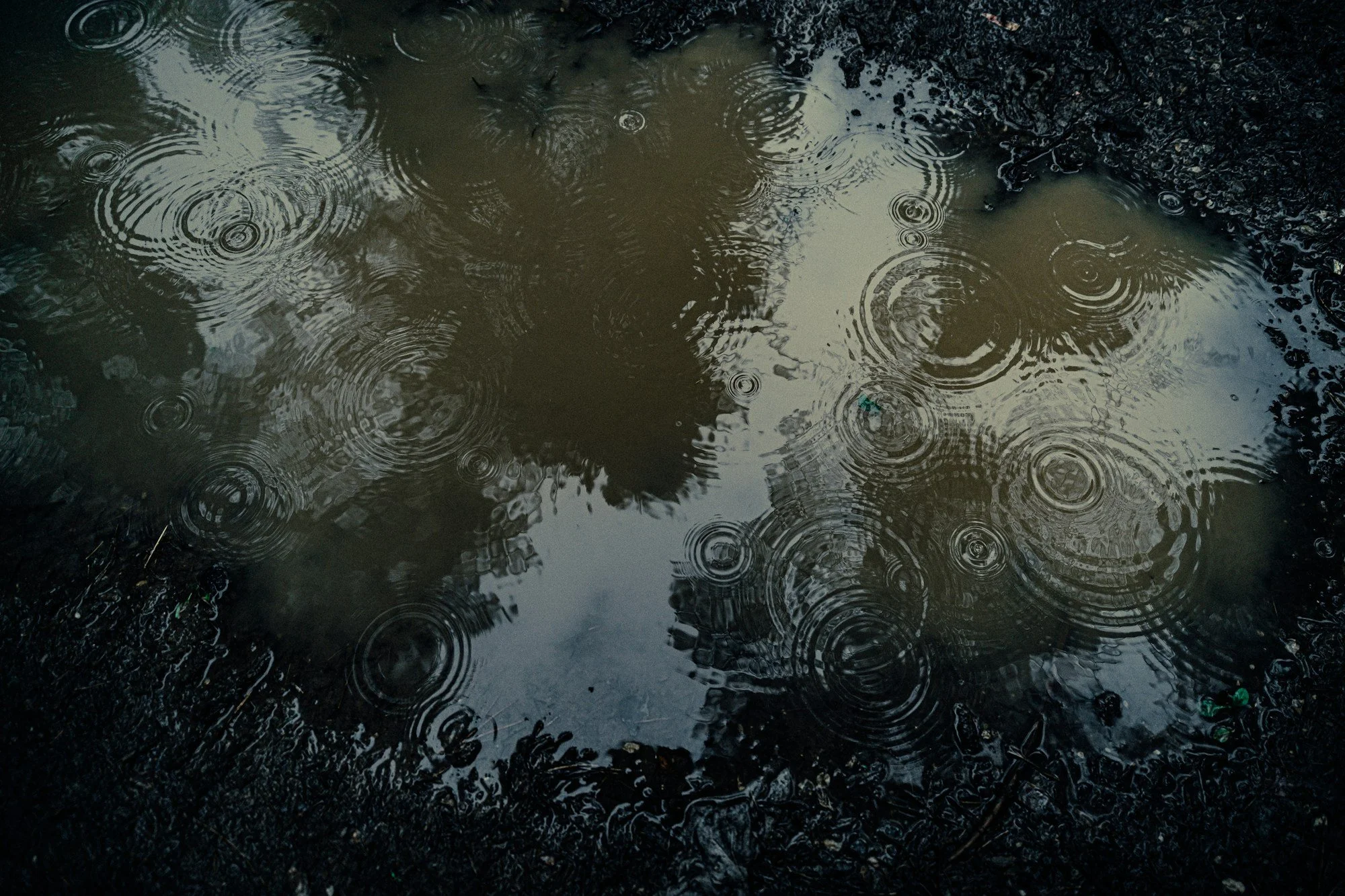
That Smell After Rain Has a Delivery System
The first drops land, and suddenly the air smells like the ground has something to say.
You might call it fresh rain, wet earth or the reason you linger by an open window. Scientists use the word petrichor for that distinctive earthy scent associated with rain on dry ground. But naming the smell leaves a wonderfully practical question: how does something down there get all the way up here? [1]
A raindrop, it turns out, can do more than make things wet.
In a 2015 study, MIT researchers Young Soo Joung and Cullen Buie investigated drops striking porous surfaces, including soil. Their experiments showed that impacts can generate aerosols: tiny droplets suspended in the air. Material from the surface can travel with them. The ground is not simply receiving water. Under the right conditions, it is sending something back. [2]
The high-speed footage makes the process easier to picture. A drop meets the surface and flattens. Tiny trapped air bubbles rise through it and burst, releasing a fine spray. Think of the little burst above a fizzy drink, scaled to an event you would ordinarily overlook on a garden path. [1]
The researchers proposed this as a way aromatic material could reach the air. That distinction matters: demonstrating the bubble mechanism is not the same as proving that it explains every scent you notice in every rainstorm. [1]
There is a counterintuitive detail, too. In their laboratory tests, conditions representing lighter and moderate rain produced more aerosols than the heavy-rain conditions. A harder impact did not simply mean a bigger airborne delivery. Speed and the surface's properties affected what happened. [1, 2]
So the charming version of the story, rain smells lovely because rain is lovely, has acquired some moving parts.
That does not make the experience less enjoyable. Knowing there is a mechanism gives you another thing to notice. The next time you are somewhere sheltered as a shower begins, pay attention to the order of the scene. First the sound on a roof. Then the darkening pavement. Perhaps a change in the air. Your version may be different, which is part of the interest.
You do not need to identify the chemistry or turn the moment into an experiment. You can simply recognize that the familiar sometimes contains a very small event happening far too quickly for your eyes.
We tend to give wonder a large travel budget. A spectacular landscape. A rare animal. A sky worth driving out to see. Those are excellent options. But a drop arriving on the ground can also carry a question worth following.
Sometimes the weather report is falling from the sky, and the interesting part is rising from the soil.
Sources & further reading
1. Jennifer Chu, MIT News: Rainfall can release aerosols, study finds. January 14, 2015.
https://news.mit.edu/2015/rainfall-can-release-aerosols-0114
2. Joung & Buie: Aerosol generation by raindrop impact on soil. January 14, 2015; Nature Communications 6, 6083; DOI 10.1038/ncomms7083.
https://dspace.mit.edu/entities/publication/04a89902-bea5-41d4-8402-3293b7a95729
