This Bird Can Sleep Without Landing
A nap usually begins with finding somewhere to put yourself. A bed. A sofa. That chair you insist you were only resting your eyes in.
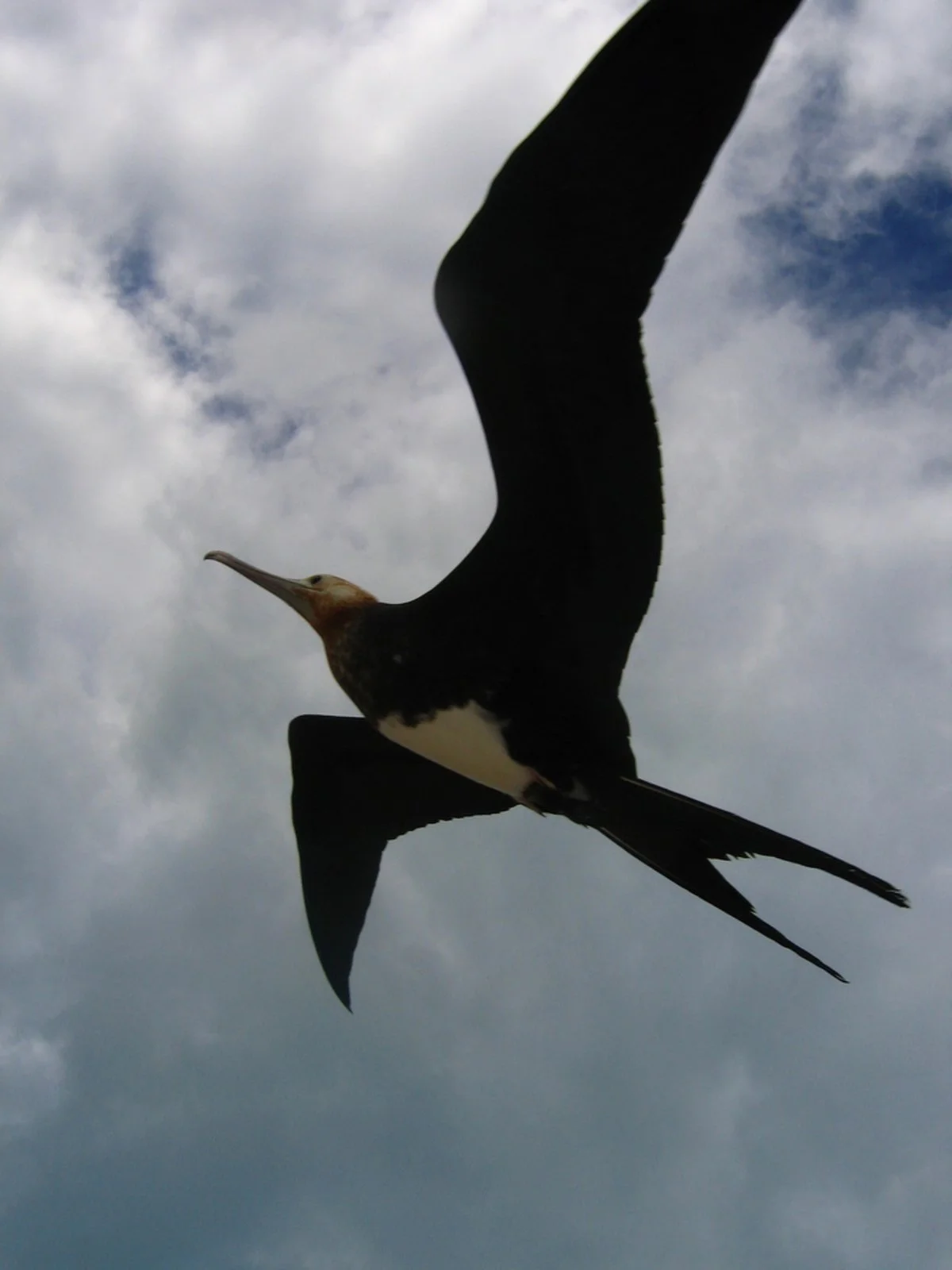
For a great frigatebird over the ocean, landing is not always part of the arrangement.
In research published in 2016, scientists recorded the brain activity of great frigatebirds during ocean flights lasting up to ten days. The recordings showed sleep while the birds were airborne. Sometimes one brain hemisphere slept; sometimes both did at once. [1]
The second part is the one that makes you read the sentence again.
An appealing explanation had been that a flying bird could keep one side of its brain awake to maintain control while the other rested. That happens, but it was not the whole story. Measuring both hemispheres meant the researchers could discover something less tidy than the original expectation. [1]
There is a lovely piece of scientific discipline here. A bird staying aloft for a long time does not, by itself, prove that it sleeps there. Perhaps it postpones sleep. Perhaps something else is happening. Flight tracking answers where the bird went. Brain recordings help answer what state it was in. [2]
The team worked with nesting female great frigatebirds in the Galápagos. Small devices recorded brain activity and head movement; GPS equipment tracked location and altitude. This was a study of particular birds doing a particular kind of flying, not permission to announce that every bird sleeps on every journey. [2]
And these were hardly luxurious nights away. The birds averaged about 42 minutes of sleep per day in flight, compared with more than twelve hours per day on land, according to the research team's account. Their ability to sleep aloft did not mean they obtained their usual amount there. [2]
That leaves a more interesting question than the simple yes-or-no one: how do they manage? The 2016 study documented the behavior without settling all the reasons such limited sleep was possible during those trips. [1, 2]
It is tempting to turn an animal's remarkable ability into a lesson about our own efficiency. Resist that temptation long enough to enjoy the bird. This is not a productivity method with feathers. It is a discovery about another animal's life.
If you follow the paper linked below, look at the figure descriptions as well as the headline. The researchers connect measurements of movement with recordings of brain activity. The evidence becomes more interesting when you can see what had to be measured to earn the claim.
The bird is impressive. So is the decision to stop saying it must be asleep and find a way to ask.
Sources & further reading
1. Rattenborg and colleagues: Evidence that birds sleep in mid-flight. August 3, 2016; Nature Communications 7, 12468; DOI 10.1038/ncomms12468.
https://pubmed.ncbi.nlm.nih.gov/27485308/
2. Max Planck Society: First evidence of sleep in flight. August 3, 2016.