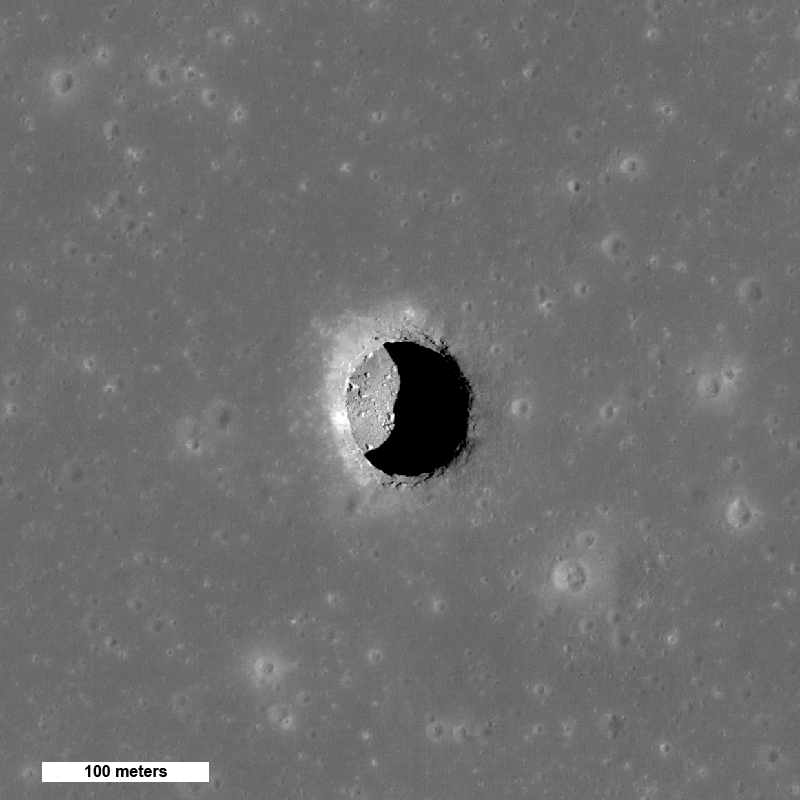
Scientists have found radar evidence of a cave extending from a pit in the Moon's Mare Tranquillitatis. The 2024 finding came from a new analysis of measurements gathered in 2010. It does not mean someone has photographed a whole underground chamber or walked inside.
Look at the image. The floor is partly visible. The wall casts a deep shadow. At first, it resembles an enormous puncture in a place we are accustomed to seeing as a bright disc.
The interesting question is what happens beyond the part the camera can see.
A hole and a passage are different discoveries
An orbital photograph can show a surface opening without settling whether it continues sideways underground. NASA reports that the reanalysis of its Lunar Reconnaissance Orbiter's Mini-RF radar data found evidence of a cave extending more than 200 feet from the pit's base.
That is a measured clue to something hidden, not a complete floor plan. The cave's full extent remains unknown.
One proposed origin is ancient lava. A flow can leave a tunnel beneath a hardened surface; if part of the roof later collapses, an opening can expose what lies below. NASA compares such openings to skylights.
Read the photograph honestly
The image here is an actual orbital observation, not an artist's imagined underground Moon. You can inspect the rim, shadow and boulders. You cannot use those visible details alone to trace the cave's shape.
Try separating two questions while looking: What is in the photograph? What do other measurements add? It is an enjoyable little exercise in how a scientific picture becomes evidence without becoming evidence for everything.
The distinction also makes the discovery more interesting. A hidden space does not have to be fully mapped to be a worthwhile finding.
Old measurements can answer new questions
The radar observations preceded the 2024 analysis by roughly fourteen years. The spacecraft did not need to return to the past and collect them again. Researchers revisited information already available with a particular question in mind.
It is tempting to turn every lunar cavity into a ready-made address for future astronauts. This result does not establish a safe, accessible home. It establishes evidence worth investigating.
For now, there is enough wonder in that dark opening: a familiar world overhead, with a part we are only beginning to infer beneath its surface.
Keep exploring
Sources and image credit
Mare Tranquillitatis pit, photographed by the Lunar Reconnaissance Orbiter's narrow-angle camera. The full frame spans 400 meters; north is up. Credit: NASA/Goddard/Arizona State University.