
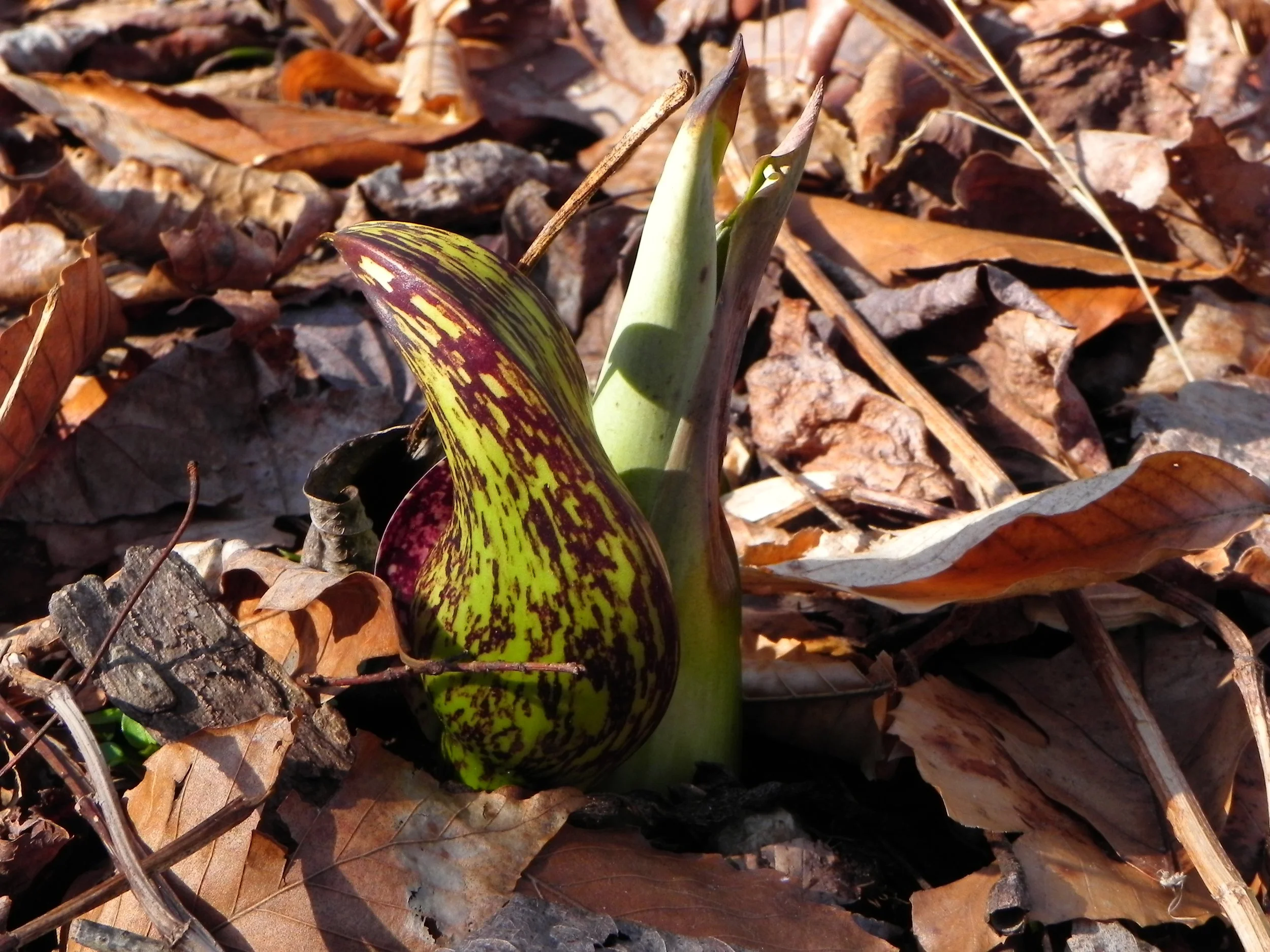
Eastern skunk cabbage at Great Falls Park. This ordinary photograph shows its form, not its temperature. National Park Service, public domain.
Eastern skunk cabbage can generate its own heat as it flowers. The process is called thermogenesis, and it comes from the plant’s metabolism. This helps explain how a low-growing wetland plant can begin flowering while the ground around it is still cold, sometimes with snow remaining nearby.
There is no heating cable under the leaves. This is a living plant doing something many of us would not think to ask a plant to do.
The hood is not the whole flower
Look at the National Park Service photograph. The green-and-maroon structure curves up from a carpet of old leaves. Its mottling makes it easy to study as a shape and easy to overlook as a plant if you are expecting petals.
That protective hood is called a spathe. Inside sits the spadix, a compact structure bearing many small flowers. The conspicuous outer wrapping and the flowers it shelters are different parts of the arrangement.
The Forest Service describes heat produced by respiration protecting the developing flowers from freezing. University of Wisconsin–Madison Extension explains that the spadix can stay warmer than the surrounding air. The photograph alone cannot establish any of that. It records reflected light, not a temperature measurement.
This is a useful way to enjoy a science image: notice exactly what is visible, then ask what the research adds.
Warmth, with an unusual invitation
The plant’s common name supplies another clue. Its unpleasant scent attracts insects, including flies, that can carry pollen. A flower does not have to smell delightful to a person to be interesting to a pollinator.
The species, Symplocarpus foetidus, grows in wet habitats in eastern North America. Its flowering structures appear before the broad leaves that become conspicuous later. A patch you recognize as lush greenery in a warmer month can therefore have a very different early-season appearance.
If you visit an appropriate park when it flowers, stay on established routes and leave the plant intact. A photograph from the path is enough. This is an observation invitation, not a collecting or tasting project.
Try looking at the image once more before reading the caption. The curled edges, mottled surface and surrounding leaf litter were there on the first pass. Now there is an additional question tucked inside the hood: how warm is it in there?
You cannot answer that by looking harder. But knowing that a plant can make the question worth asking changes what there is to see.
Keep exploring
Follow your curiosity in the Purpose Neighborhood · Find another surprise in the Curiosity Room
Research references
Image credit
National Park Service, Great Falls Park. NPGallery asset CA8559B0-1DD8-B71C-0706942B1B581459. Public domain.
