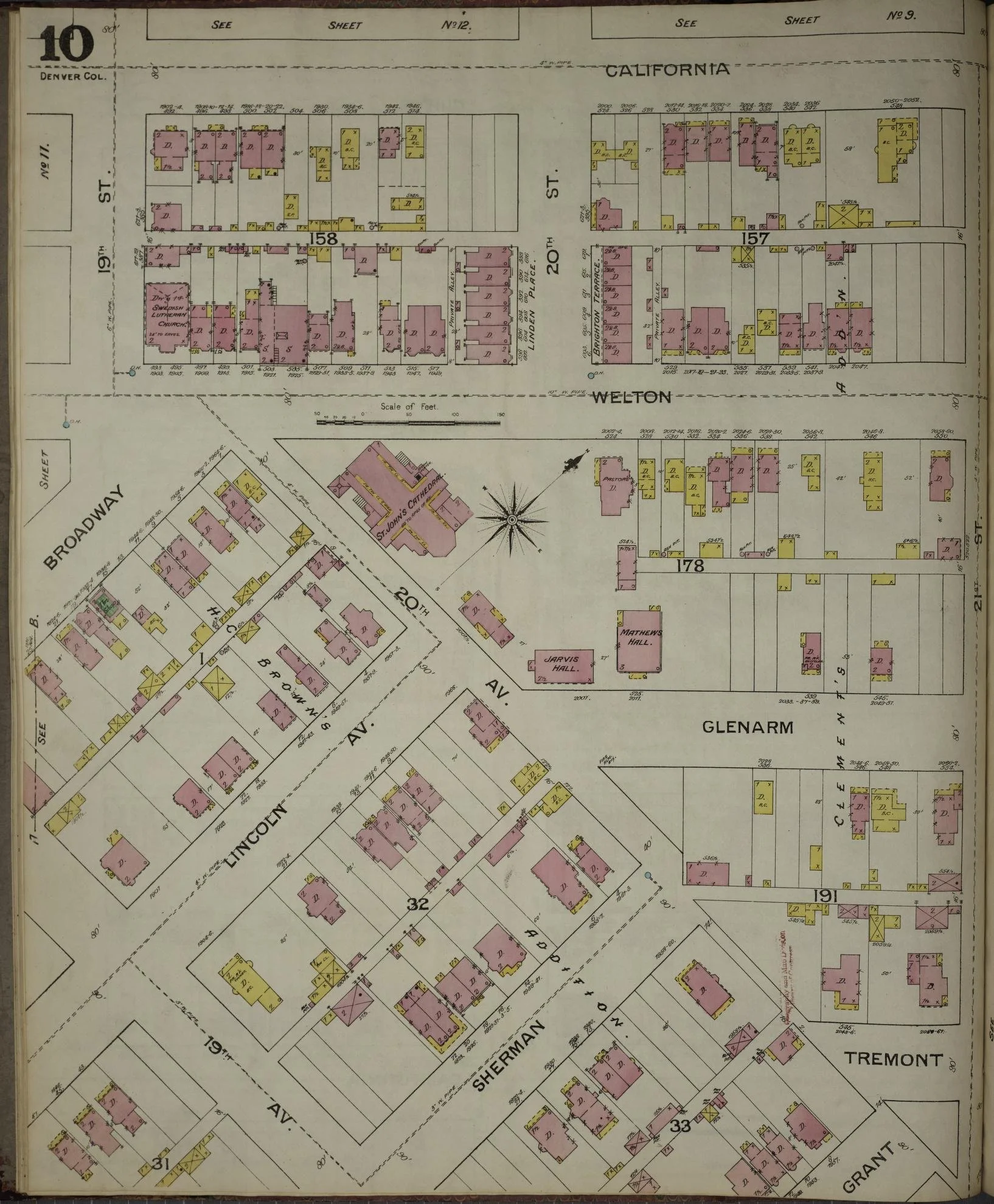
Denver, 1887, sheet 10, shown as image 11 in the digital atlas. Sanborn Map Company. Public-domain scan from the Library of Congress.
To explore what used to stand on a familiar block, look for its town in the Library of Congress Sanborn fire-insurance maps. Choose an edition, find the block using its index or key map, and read that edition’s legend before interpreting the colors. These are historical records of buildings and their uses, made for insurers.
They are also an absorbing way to spend a half hour with a street you thought you knew.
Look at the 1887 Denver sheet here. California, Welton and Glenarm appear in large lettering. Tiny building outlines sit inside larger parcels. Near the middle, the map names St. John’s Cathedral. The page offers an immediate question: what would the walk between those corners have looked like?
Begin with one corner
Resist the temptation to reconstruct the whole city. Pick one intersection or a place with personal meaning: a grandparent’s street, a former workplace, the block where you buy bread. Search the collection by city and state. Availability varies, so a nearby town can be a satisfying second choice.
Record the town, edition date, sheet number and source link. The digital image number may differ from the number printed on the sheet. Here, image 11 displays sheet 10. Keeping both makes it easier to return to the exact page.
Then consult the legend. The Library’s guide explains common abbreviations such as D for dwelling and S for store, but symbols and their use changed. Let the map’s own key settle the question before deciding that a colored rectangle means what you think it means.
Keep a fact and a question side by side
Try two columns in a notebook: “The map shows” and “I wonder.” A printed business name belongs in the first. A story about who worked there belongs in the second until another record supports it.
That small distinction makes the search more interesting. A map can point you toward a city directory, an old newspaper or a librarian’s local-history collection. It cannot supply every person’s experience of the place.
Street names and numbering can change, too. An old number matching today’s number is a lead to check, not proof that you have found the same building. Nor does a historical outline establish a present property boundary or a building’s current safety.
Save one detail that makes you want to look again. On your next ordinary walk, you may find yourself pausing at an ordinary corner with a much better question.
Keep exploring
Explore the Purpose Neighborhood · Keep exploring the Curiosity Room
Research references
Image credit
Library of Congress, Geography and Map Division, Sanborn Maps Collection. Sanborn Map Company, Denver, 1887, sheet 10.