
From Orbit, Sunset Can Come Around Again in About 90 Minutes
Miss a sunset on the ground and you generally have a wait ahead of you. On the International Space Station, another can be roughly an orbit away.
The station circles Earth in about 90 minutes. That rapid journey carries its crew repeatedly between sunlight and Earth’s shadow, producing about 16 sunrises and 16 sunsets during a 24-hour day.
The word about matters. NASA also describes the count as 15 or 16. This is an orbital rhythm, not a promise that every window offers sixteen identical performances on demand.
The surprising part is that an astronaut has not lived through sixteen ordinary calendar days. The clock and the view are describing different things. On the ground, our familiar cycle of daylight follows Earth’s rotation beneath the Sun. In orbit, the station’s fast trip around the planet adds a much quicker rhythm of light and shadow.
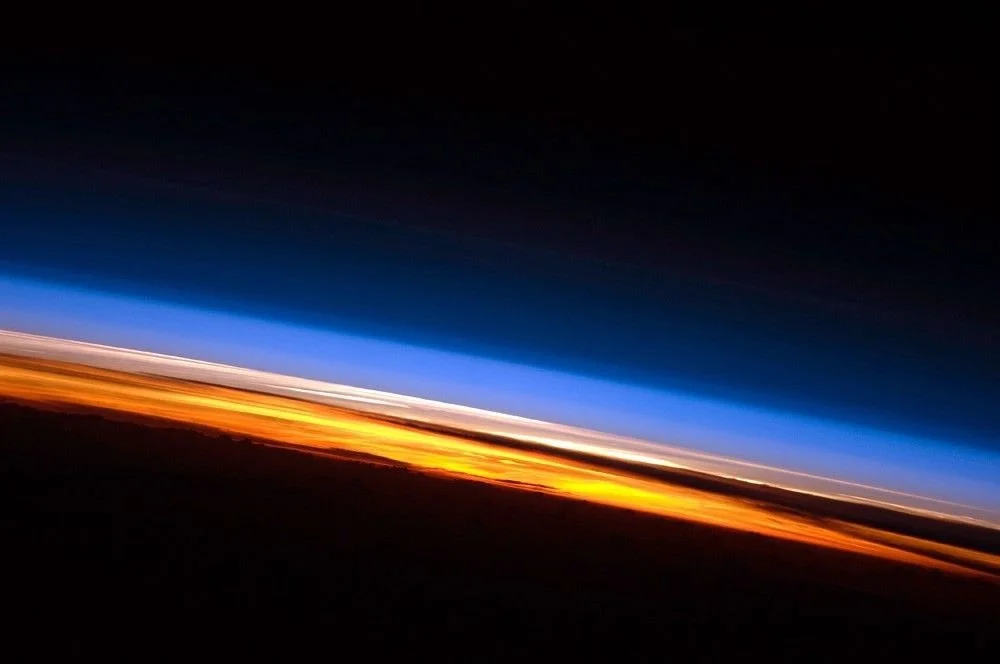
In the photograph above, the planet’s edge runs across the frame in narrow bands of orange, pale light and blue. The Expedition 23 crew captured it over the southern Indian Ocean on May 25, 2010. NASA’s scientific caption interprets the colored bands as views through different regions of the atmosphere, with clouds and airborne particles contributing to their appearance.
It is a real photograph, though not an untouched file straight from the camera. NASA explains that its published version was cropped and enhanced for contrast, and that lens artifacts were removed. Those details matter because an extraordinary view deserves an accurate introduction.
The image invites a small act of imagination. Picture the end of the workday arriving outside your window, then arriving again while the same workday continues. Sunset would no longer be a dependable cue that you were nearly finished.
That imagined scene is not a report of how every astronaut feels. It is one way to recognize how much our ordinary sense of time depends on where we are standing, and how we are moving.
There is pleasure in learning a fact that does not need to become a productivity technique. Nobody has to squeeze more sunsets into an evening. The discovery can simply widen the picture.
Somewhere above the familiar horizon, evening is coming around again.
Sources
NASA Earth Observatory, Sunset from the International Space Station, June 14, 2010. Primary astronaut photograph, acquisition record and scientific caption.
https://science.nasa.gov/earth/earth-observatory/sunset-from-the-international-space-station-44267/
European Space Agency, Where is the International Space Station?, page dated July 25, 2001, current reference page accessed November 6, 2026. Orbital period and daily sunrise count cross-check.
https://www.esa.int/articles/where-is-the-international-space-station
NASA, First Rays of an Orbital Sunrise, 2022 image feature. Describes 15 or 16 daily sunrises and sunsets; accessed November 6, 2026.
https://www.nasa.gov/image-article/first-rays-of-an-orbital-sunrise/
Sources checked November 6, 2026.
