Body
An Octopus Can Taste What Its Arms Touch
Imagine reaching into a cupboard and learning something about the food by touching the packet. No label. No opening it. Your hand has collected chemical information of its own.
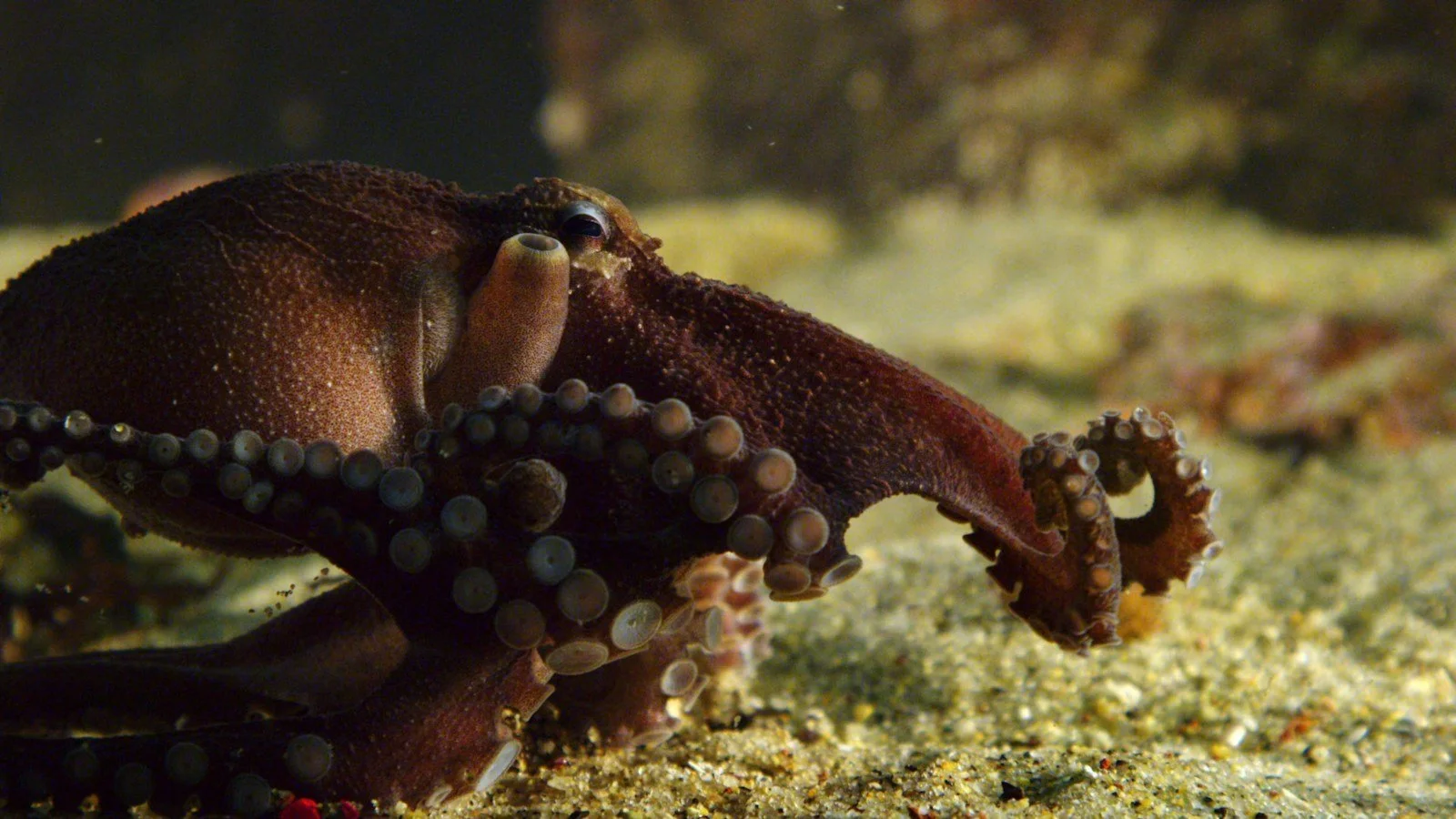
That is an imperfect human comparison for a remarkable octopus ability. The suckers along its arms can detect chemicals through contact as well as respond to touch. Researchers call this “taste by touch.” [B1]
The phrase is wonderfully strange. It is also worth taking seriously enough to ask what it actually means.
In a 2020 study of the California two-spot octopus, Octopus bimaculoides, researchers identified specialized chemical sensors in the suckers. These chemotactile receptors respond to substances including poorly water-soluble compounds. The team also distinguished cells that respond to mechanical touch from cells that respond to chemical stimuli. The sucker is doing more than holding on. [B1]
Think about the difference between information drifting through water and information available when an animal makes contact with a surface. The latter can matter to an octopus exploring a crevice it cannot inspect directly with its eyes. In laboratory observations, arms probed through an opening, attached to prey when they encountered it, and brought it back toward the body. [B1]
What looks like rummaging has a sensory story inside it.
The investigators did not reach that conclusion merely by watching an octopus move. They studied receptors in laboratory cells to test how they responded to different substances, then examined the animals' responses to chemical cues. Harvard's account of the work describes that movement between the molecular experiments and observations of the living animals. [B2]
A follow-up paper in 2023 examined an octopus receptor's structure. It identified a binding pocket suited to greasy compounds, helping explain how the receptor detects substances that do not readily spread through seawater. The work adds a molecular explanation to an ability that sounds, at first, almost like a party trick. [B3]
There is a limit to the comparison with our own eating experience. Detecting a chemical does not tell us what that sensation feels like to an octopus. We should not imagine eight human tongues, each privately reviewing the menu. “Taste” is a useful entry point into the science, not a transcript of the animal's thoughts.
That distinction makes the subject more interesting. An octopus does not have to experience the world as we do for its way of exploring to be sophisticated.
The next time you watch documentary footage of one moving over rocks, look at the suckers. Notice where an arm pauses, reaches or curls. You will not be able to identify a chemical signal from a video, but you may find yourself watching the animal differently.
It is easy to admire an octopus for everything its arms can do. The better surprise is everything those arms can find out.
Sources and Additional Reading
B1 Lena van Giesen, Peter B. Kilian, Corey A. H. Allard and Nicholas W. Bellono. Molecular Basis of Chemotactile Sensation in Octopus. Cell 183, 594–604.e14, October 29, 2020. DOI: 10.1016/j.cell.2020.09.008. Primary study; author manuscript available through PMC. [https://pmc.ncbi.nlm.nih.gov/articles/PMC7605239/] Read source
B2 Juan Siliezar, Touch and taste? It’s all in the suckers. Harvard Gazette, October 29, 2020. Reporting from the institution conducting the research. [https://news.harvard.edu/gazette/story/2020/10/octopus-suction-cups-hold-its-taste-and-touch-sensors/] Read source
B3 Corey A. H. Allard and colleagues. Structural basis of sensory receptor evolution in octopus. Nature 616, 373–377. April 12, 2023. DOI: 10.1038/s41586-023-05822-1. [https://pmc.ncbi.nlm.nih.gov/articles/PMC10228259/] Read source