
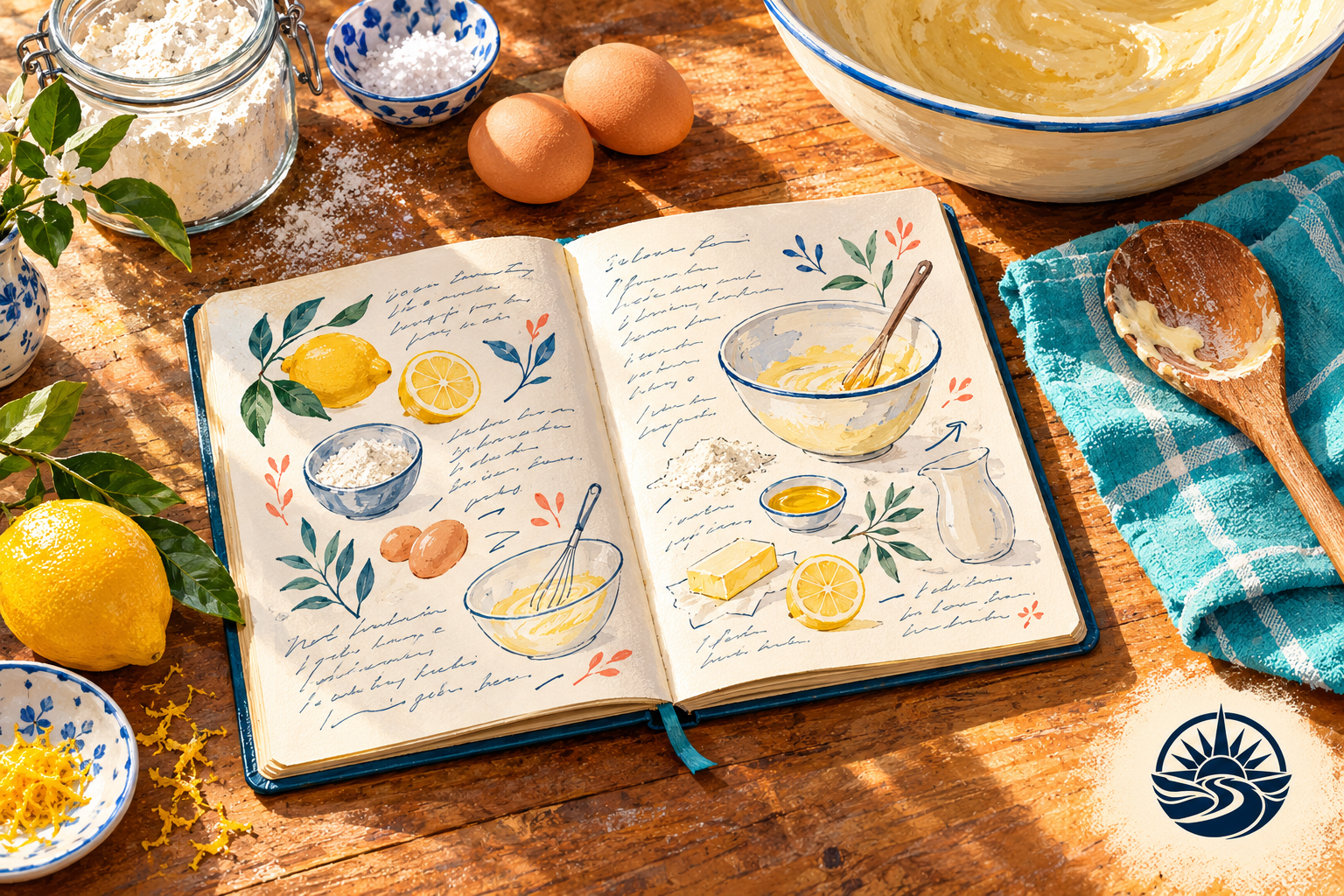
What a Handwritten Recipe Keeps Besides Ingredients
A neatly typed recipe tells you what to do. A handwritten one may also reveal that somebody changed their mind halfway through the sugar.
There is the original amount. There is the correction. There is the instruction that makes perfect sense to the person who wrote it and leaves everyone else wondering what, precisely, a little means.
These are imagined examples, but the larger point has a very real home. The Library of Congress maintains a research guide to cookbooks, recipes and menus in its Manuscript Division. Food appears inside collections devoted to people's lives, alongside the records we more readily recognize as history. [1]
One item is a recipe for Featherlite Pancakes in the Rosa Parks Papers. In a September 2026 post, the Library describes Parks recording it on the back of a deposit envelope from Detroit's First Independence National Bank. The post pairs the handwritten version with a transcription. [2]
An envelope. Not special stationery purchased for the preservation of an important life. An available place to put something she wanted to keep.
The document does not tell us every occasion on which she made pancakes, who ate them or what the kitchen conversation sounded like. We should not supply those missing details simply because they would make a lovely scene. What it does offer is an everyday object within a much larger record of a person.
That is one reason to look again at the recipes closer to home. The ingredients might be available elsewhere. The way someone wrote them down is particular.
Perhaps a page contains a substitution, a borrowed name or an amount adjusted for a larger table. Those details can prompt questions without answering them for us. Who supplied the recipe? Was the change an experiment, a preference or a matter of what was in the cupboard? If the person is available and wants to talk, asking may be more interesting than guessing.
There is room for humor in the answer, too. The celebrated family specialty may have begun on the back of a box. The secret ingredient may have been whichever brand was on sale. Affection does not require an origin story with violins.
A small way to keep the context is to photograph one recipe you care about, then make a separate note of what you actually know: whose handwriting it is, who shared it and any changes they explained. Mark uncertainty as uncertainty. You do not need to turn the entire kitchen drawer into an archival project this weekend.
And you do not need an inherited collection. A recipe sent by a friend, a dish you adapted or something you write down today can be a beginning. The ordinary present is where this material comes from.
Keep the instructions. Leave a little room for the person who wrote them.
Sources & further reading
1. Library of Congress: Cookbooks and Recipes in the Manuscript Division. Guide updated August 25, 2026.
https://guides.loc.gov/mss-cookbooks-recipes
2. Michelle Krowl, Library of Congress: Of Note: Rosa Parks's Pancake Recipe. September 24, 2026.
https://blogs.loc.gov/manuscripts/2026/09/of-note-rosa-parkss-pancake-recipe/
