
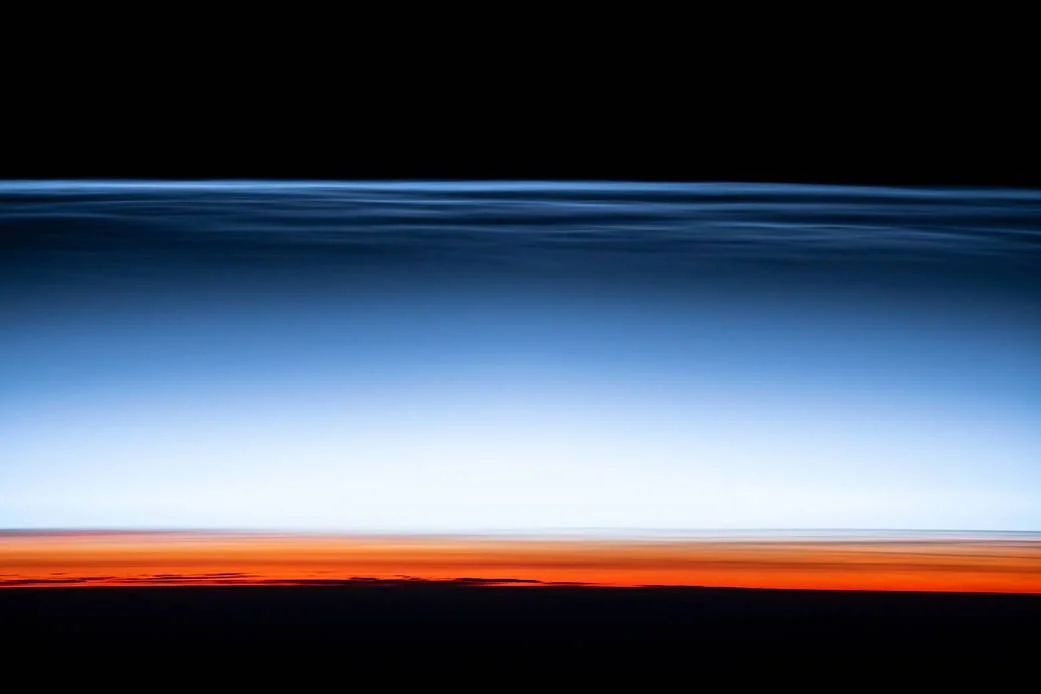
Noctilucent clouds can look luminous after sunset because they are high enough to remain illuminated by the Sun while the ground below is dark. They reflect sunlight. They are not manufacturing their own glow. [1]
That distinction makes the view more interesting, not less. Sunset is not a single switch thrown across the whole atmosphere. From your position the Sun has slipped away. Far above you, a thin cloud can still catch it.
Ice where the sky is almost over
NASA describes these clouds forming roughly 47 to 53 miles above Earth's surface, near the upper edge of the mesosphere. Water vapor freezes into tiny ice crystals at those heights. Meteor dust and other particles can provide surfaces for the ice to form on. [1]
They are also called polar mesospheric clouds. The name noctilucent points to the visual surprise: night shining. The practical explanation involves both the cloud's altitude and where the Sun is relative to the observer.
In the photograph here, the International Space Station offers a view across the curved edge of Earth. NASA identifies it as a February 12, 2020 image above the South Pacific. It is an archival photograph, not a picture of tonight's sky. [2]
The picture and the measurement are different pleasures
An astronaut photograph shows the scene. A scientific instrument can describe things a beautiful picture alone cannot establish. NASA's AIM mission mapped these clouds and their varying ice-particle density, helping researchers study where they form and how they change. [3]
A bright patch in a cloud map is therefore not simply a camera admiring a prettier part of the sky. The map is encoding a measurement. Keeping that distinction in mind makes both kinds of image easier to read.
No appointment with tonight's sky
These are seasonal high-altitude clouds associated especially with polar-region summer conditions. This story is not a forecast or a promise that you can see them from your neighborhood tonight. [1]
For now, the photograph offers enough to investigate. Follow the curve. Notice the slim pale layer against the darker Earth. Then reconsider the ordinary sentence The Sun Has Set. It has, for the person saying it. A little higher up, the light may still be arriving.
Keep exploring
Sources and image credit
NASA, image iss062e005412. Editorial reuse under NASA Images and Media Usage Guidelines; no endorsement implied.
