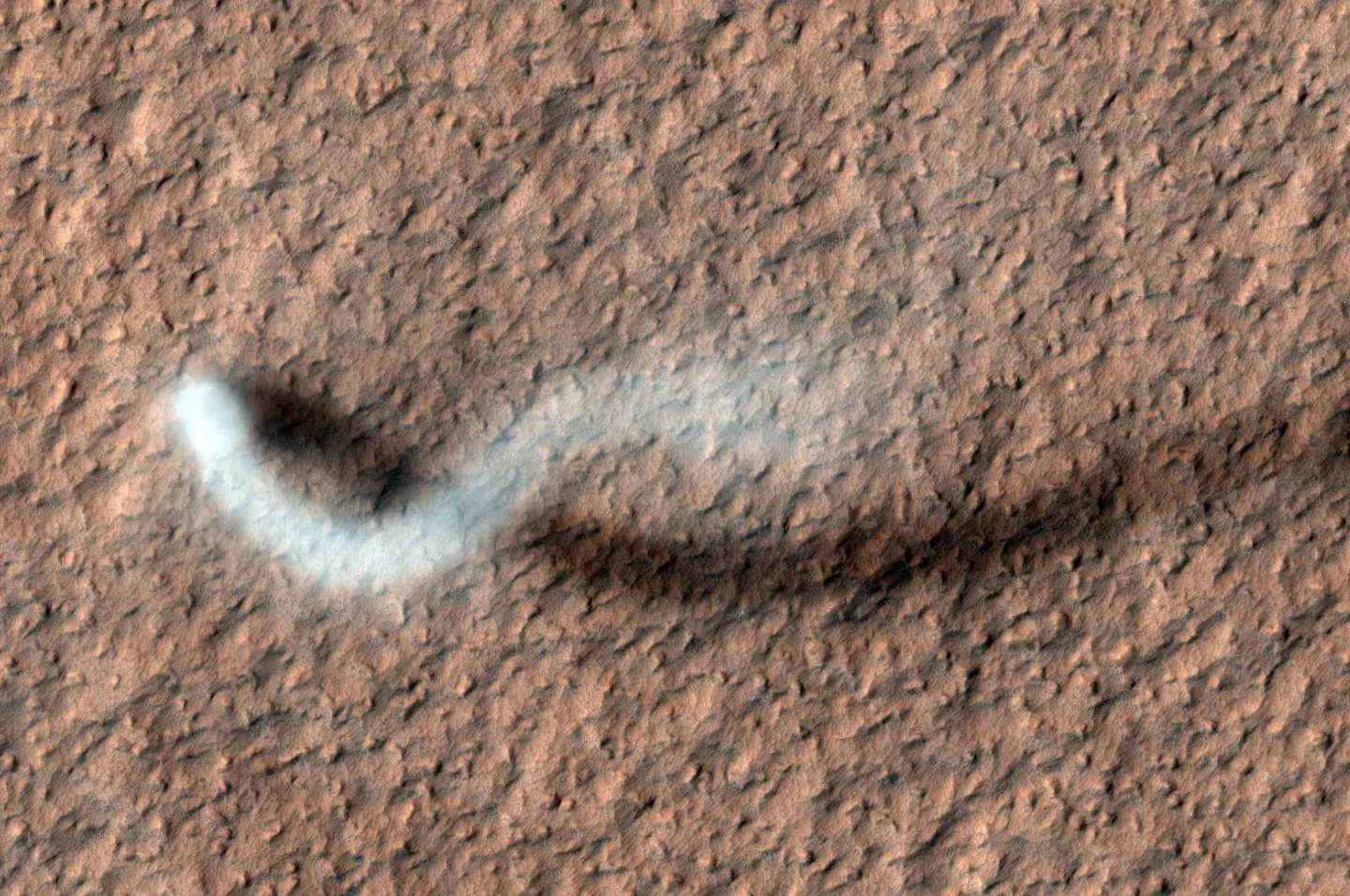
HiRISE caught this dust devil over Amazonis Planitia on February 16, 2012. Look for the darker trace beside the plume.
Your eye goes to the pale S first. Look beside it. The darker trace is the shadow, and its length helped NASA’s team estimate that the pale swirl rose about 800 meters above Mars. The dust plume itself was only about 30 meters across.
The HiRISE camera on NASA’s Mars Reconnaissance Orbiter caught the whirlwind over Amazonis Planitia in February 2012. The whole published view spans about 644 meters across. The column can reach higher than the picture is wide because it rises up from the surface toward the camera.
Let the sunlight do some of the measuring
Picture a lamppost at the end of the day. Its shadow stretches as the Sun gets lower. With the Sun’s angle and the scale of a photograph, the distance between the foot of a vertical object and the tip of its shadow helps estimate how tall it is. On Mars, the dust made the moving column visible and the shadow supplied a second clue.
The plume even bends. NASA’s image notes point to a west wind partway up the column. That gives your eye another detail to look for: the dust traces the motion of air above the ground.
Look once more
Find the pale plume again, then follow the dark trace. Take a second to picture the plume standing up out of the page. A camera looking down captured enough information to help us imagine what somebody standing nearby would have had to tilt their head back to see.
Keep exploring
The Moon May Have a Downstairs
Sources and image credit
NASA Science | The Serpent Dust Devil of Mars
NASA/JPL | Orbiter catches a twister in action
NASA/JPL-Caltech/University of Arizona, Photojournal PIA15116. · Reuse terms