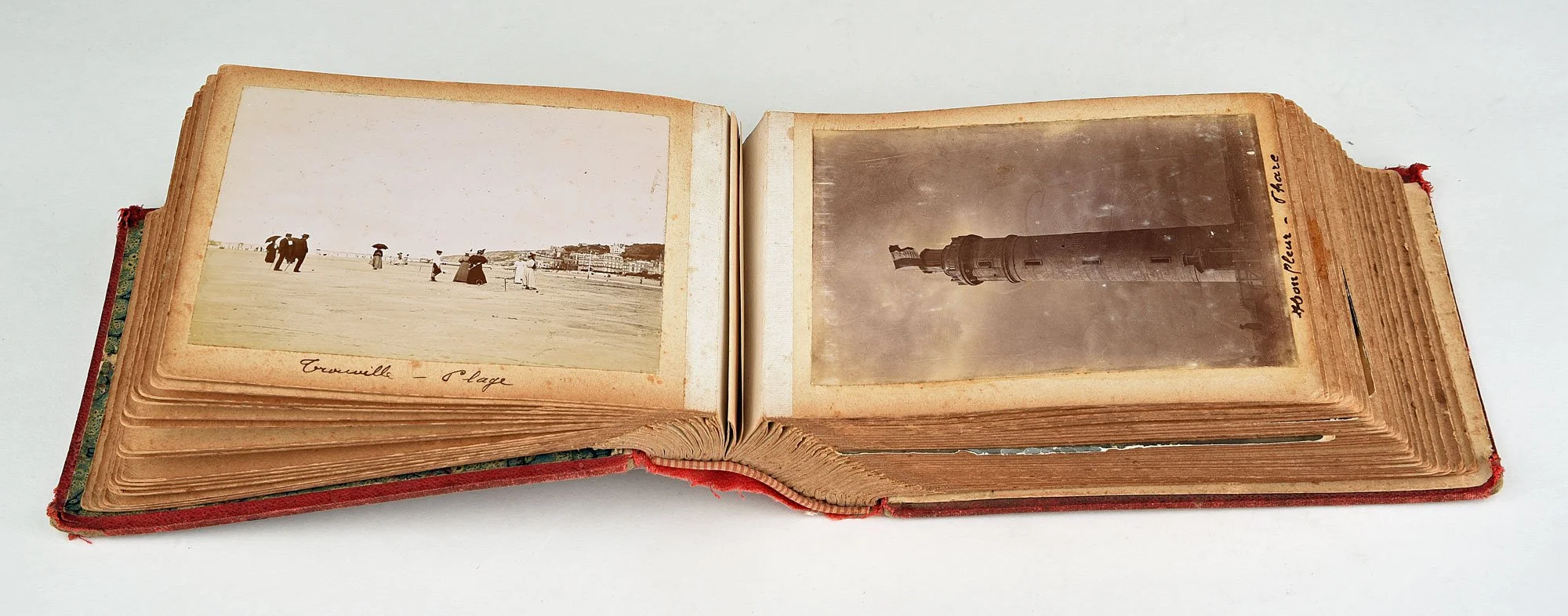
An album from around 1900 gives the photographs a place to live. The names and dates need somewhere to live, too.
Pull out five old photographs. Pick one that makes you say, “Oh, I know exactly who that is.” Start there. The most valuable part of that picture might be the thing you know before you even turn it over.
By your late forties or fifties, you may remember an aunt by a nickname no one put on paper, or recognize your grandmother’s kitchen from a strip of wallpaper. That kind of detail can be hard to find later. Put it where someone else can find it now.
Give the picture one plain sentence
Write the names you know, from left to right. Add a place, a date or a useful approximation. “Yvonne and Aunt Cookie on the porch in Dayton, probably summer 1987” does more work than “old family pictures.” If you only know a nickname, keep it. A future reader might recognize exactly that word.
Leave a question where you have one. “Possibly June, second from right” lets another relative help. A guess filed as fact is harder to untangle later.
Keep the caption with the copy
The National Archives recommends descriptive file names and digitizing both sides when the back has meaningful information. Use one matching file name for the front and another with “-back” for the reverse. Keep your longer caption in a short text file with the same base name, or put it in the image’s description field if your photo app keeps descriptions with exports.
Save the scans and captions together, and keep the originals. Send one picture to the person who is most likely to know what you missed. A specific question is easy to answer: “Who is holding the cake?” Five labeled photographs make a useful first album. You can leave the rest of the box for another day.
Keep exploring
Your Job Title Leaves Out the Best Parts
Sources and image credit
National Archives | Digitizing family papers and photographs
Album Photos-(2), Bertrand Labévue via Wikimedia Commons, CC BY-SA 4.0. Photograph in the album credited as unknown. · Reuse terms