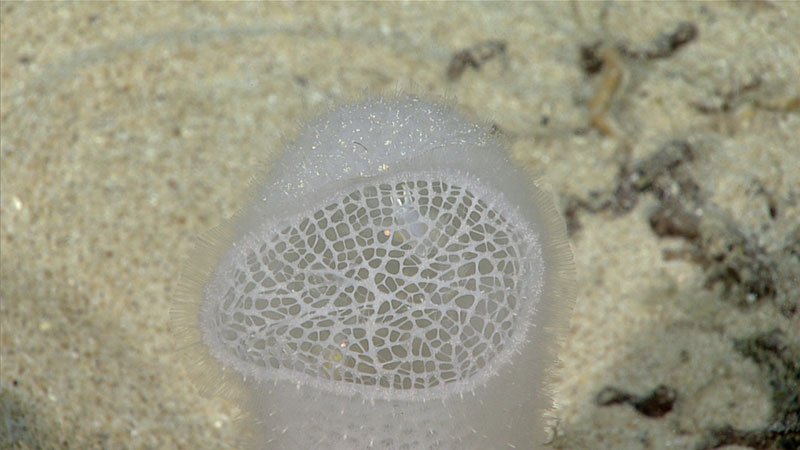
Glass sponges are animals with skeletons made from silica, the material used to make glass. They are not little sculptures abandoned on the seabed. Their glass-like supporting pieces, called spicules, can form intricate structures around living tissue.
The photograph here makes a good case for slowing down before deciding what something is. At first glance, the pale object could be a piece of lace pulled into a tube. Follow the small openings and the regular-looking pattern. It begins to resemble architecture. The NOAA photograph shows a pale, mesh-like form against the seabed. The open end offers a view into its intricate structure.
A body with an unexpected building material
NOAA explains that glass sponges attach to hard surfaces and filter tiny food, including bacteria and plankton, from the surrounding water. Some build fused skeletal structures that can remain after the animal dies. The durable framework and the living animal are related things, but they are not interchangeable.
A still photograph cannot show the movement of water through a sponge. What it can offer is time to examine a structure that might be easy to mistake for a manufactured object.
A house can have residents
NOAA describes another surprise: some glass sponges provide homes for small crustaceans. That is a biological relationship, not something this photograph alone can establish.
In the famous Venus flower basket association, shrimp can grow too large to leave the sponge while their much smaller offspring can escape. That account belongs to particular sponge-and-shrimp relationships. It is not a rule for every sponge in the ocean.
Try looking at the photograph twice: once for the overall shape, once for the pattern of openings. What first resembles lace begins to look like a framework. You can enjoy the structure without pretending the photograph answers every question about its inhabitants.
There is no need to turn it into advice about building your own life. An animal that makes a silica skeleton and shelters small neighbors is quite enough to be interested in today.
Keep exploring
See weather with corners on Saturn
Keep exploring the Curiosity Room
Sources and image credit
NOAA Ocean Exploration: Are glass sponges made of glass?
NOAA Ocean Service: What is a glass sponge?
NOAA Office of Ocean Exploration and Research. Public domain under NOAA Ocean Exploration FAQ; source caption contains no third-party restriction. Original JPEG retained unchanged, including metadata.