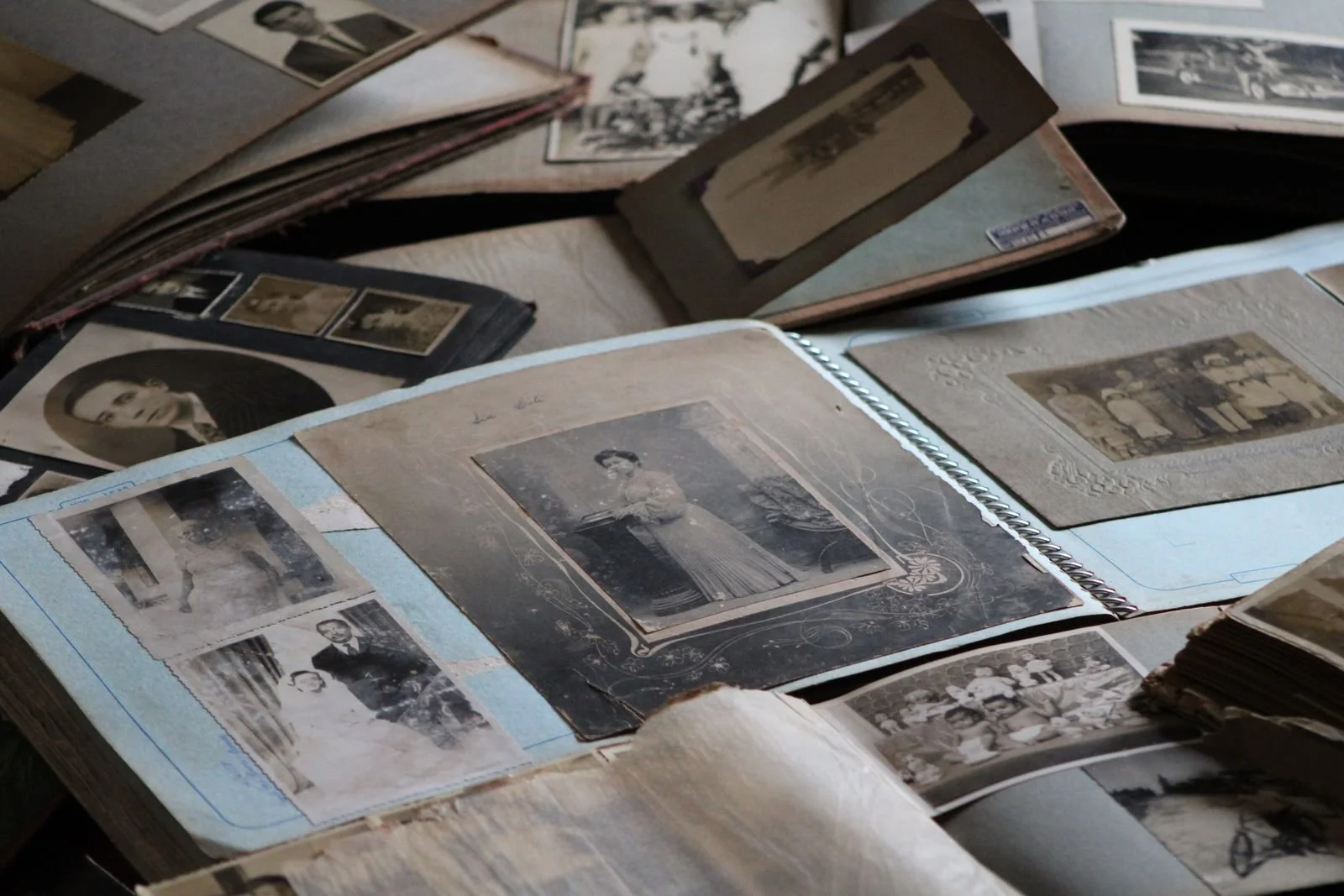
To make old family photos useful to the next person, add names, an approximate date, a place and a little context. Keep that information with the picture. For physical prints, a separate labeled enclosure is a good starting point; the National Archives advises against using ink or markers around photographs. [1]
If you are 45 or older, you may occupy an interesting position in the family picture collection. You remember people a younger relative never met. You can distinguish the two houses everyone calls Grandma’s. You know that the person in the spectacular trousers was usually much more reserved.
You may also have a box you have been meaning to sort since the last house move. Possibly the move before that. Let us keep this project smaller than the box.
Start with five photographs
Choose five pictures you actually want to talk about. An ordinary kitchen scene can be as inviting as a wedding portrait. This is an MCE starting suggestion, not an archival rule: the aim is to finish a small, satisfying piece of work.
Give each image a simple identifier, such as family-001. Use the same identifier for its scan and its caption note. Then answer what you can: who is pictured, what is happening, when and where it happened, and who took the photograph if you know. These are MCE prompts for preserving the story alongside the picture.
Write full names where possible. “Dad” is clear until somebody else becomes Dad. Add relationships if they help: “Elena Ruiz, my mother’s older sister.” A future reader will be grateful for the extra few seconds.
Leave room for the uncertain bits
A useful caption can contain a question mark. Try “probably summer 1984” or “possibly outside the first house in Tucson.” If someone supplies a detail, record who remembered it and when. Two relatives may remember the same afternoon differently. Keep both accounts identifiable rather than choosing the tidier story.
Then add one sentence the camera could not capture. The cake had collapsed before the guests arrived. Someone was home on leave. The garden belonged to a neighbor who welcomed everybody. These are prompts for your own recollection, not details to manufacture when nobody knows.
Protect the picture while adding the story
Handle prints by their edges and avoid touching the image surface. The Library of Congress recommends a clean working area and keeping photographs away from food and drink. Choose a cool, dry, stable storage location rather than an attic or damp basement. [2]
The National Archives says pencil can be used lightly on the backs of some paper prints, but not every photo surface accepts it. Writing on the enclosure avoids that uncertainty. Do not force a print through an automatic-feed scanner; the Archives recommends a flatbed large enough to accommodate the item. [1]
A conversation is enough for today
If you want another person’s help, ask about one picture rather than inviting them to solve the entire archive. “Who is beside you here?” is a comfortable opening. “Please identify these 800 people” has a rather different atmosphere.
Ask before sharing a personal story or someone’s image publicly. A private family caption file does not need to become a social-media project. When you finish, keep the notes beside the corresponding copies and make another copy somewhere separate.
Five pictures with names and a little life around them are five pictures someone else can enter. You can stop there today. The box will still be a box, but one small part of it will have started talking.
Keep exploring
Put your eye for family history to work →
Explore the PURPOSE Neighborhood →
Research references & image credit
Photograph by Thiago José Amaral / Pexels, used under the Pexels license. Illustrative archival albums; the pictured people are not identified as the author’s family.