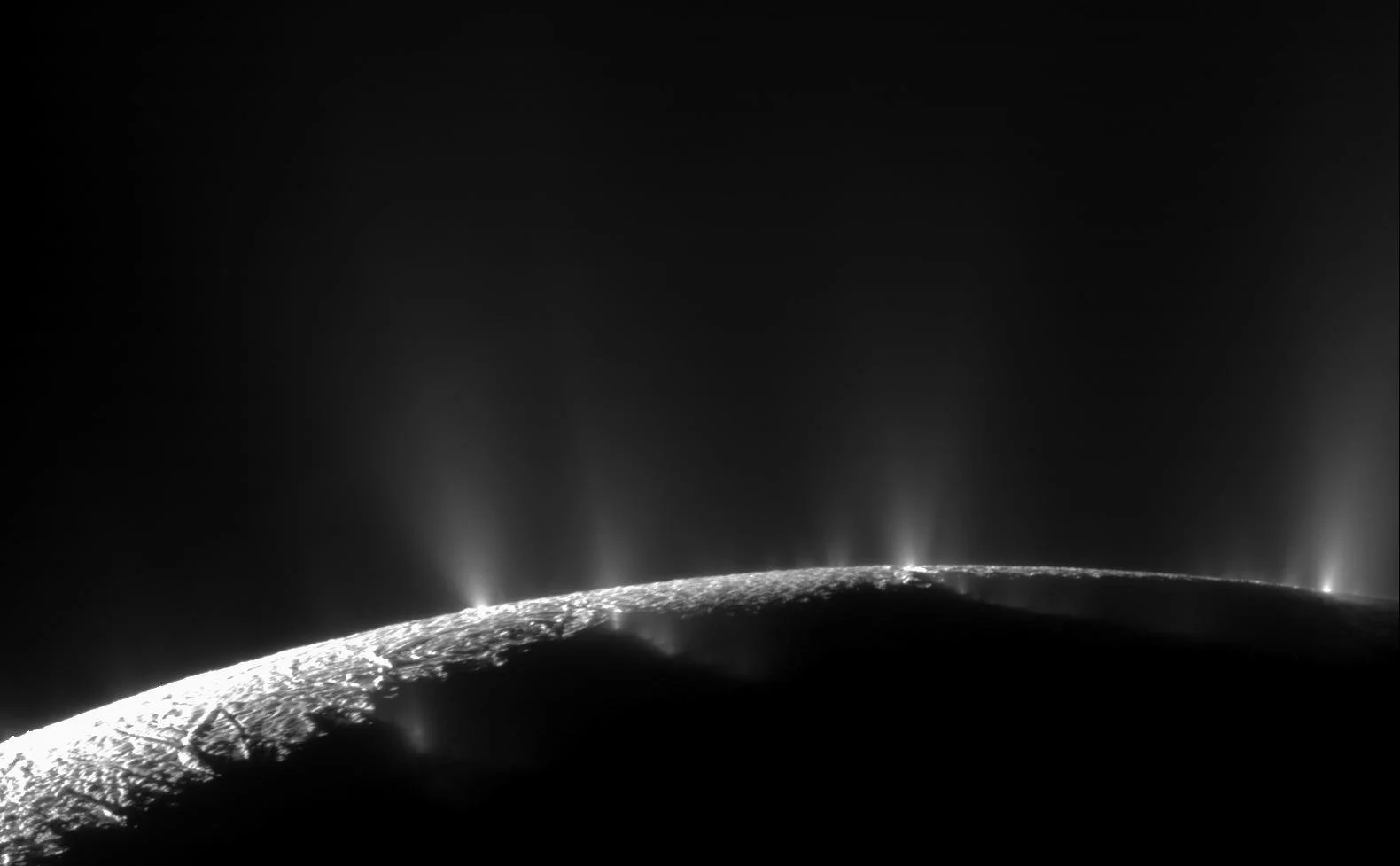
Cassini image mosaic of plumes near Enceladus’s south pole. Credit: NASA/JPL/Space Science Institute. Archival scientific image, PIA11688.
Enceladus, a small moon of Saturn, sprays water vapor and ice particles through fractures near its south pole. The material is connected to a salty ocean beneath its frozen surface. That makes this distant ocean unusually accessible: a spacecraft can sample material from it without first landing and drilling through the ice.
An ocean that sends samples into space. That is an excellent reason to look twice at an apparently quiet ball of ice.
Start with the bright edge
In the Cassini mosaic above, much of the moon is dark. The pale sprays stand out against the blackness beyond its curved edge. This is a view assembled from spacecraft images, not an artist’s imagined eruption.
The NASA image record identifies the source region as the south-polar fractures informally called the “tiger stripes.” The photograph lets you see escaping material. It does not let you see the ocean itself. Keeping those two things separate makes the picture more interesting, not less.
A photograph can raise the question. Other measurements help answer it.
How do you study water you cannot see?
Cassini’s observations of gravity and the moon’s slight wobble helped scientists infer a global ocean. The mission also examined material escaping from the interior. Salts, silica and organic compounds in that material have made Enceladus an important place to investigate conditions that could support life.
There is a crucial distinction here: chemistry relevant to life is not a discovery of life. “Organic” describes carbon-based chemistry; it is not a certificate that an organism made a molecule. The exciting question is what the ingredients, energy and environment together might allow.
NASA’s account of the moon explains another surprising consequence. Some of the escaping ice helps supply Saturn’s E ring, while much of the material falls back to the surface. A moon can contribute to a planetary ring and dust itself with returning ice at the same time.
A different way to look at a space photograph
Give the image a few seconds before reading its explanation again. Where do the plumes seem narrow? Where do they spread? Which parts of the surface disappear into shadow?
You do not need to identify every feature. The useful habit is noticing what the image actually shows, then asking what additional evidence would be needed for the larger claim.
In this case, the larger claim is extraordinary: there is an ocean under that ice. The little bright sprays are one way it lets the rest of the solar system know.
Keep exploring
Sources and image credit
NASA/JPL/Space Science Institute. Informational editorial use under NASA media guidelines: https://www.nasa.gov/nasa-brand-center/images-and-media/