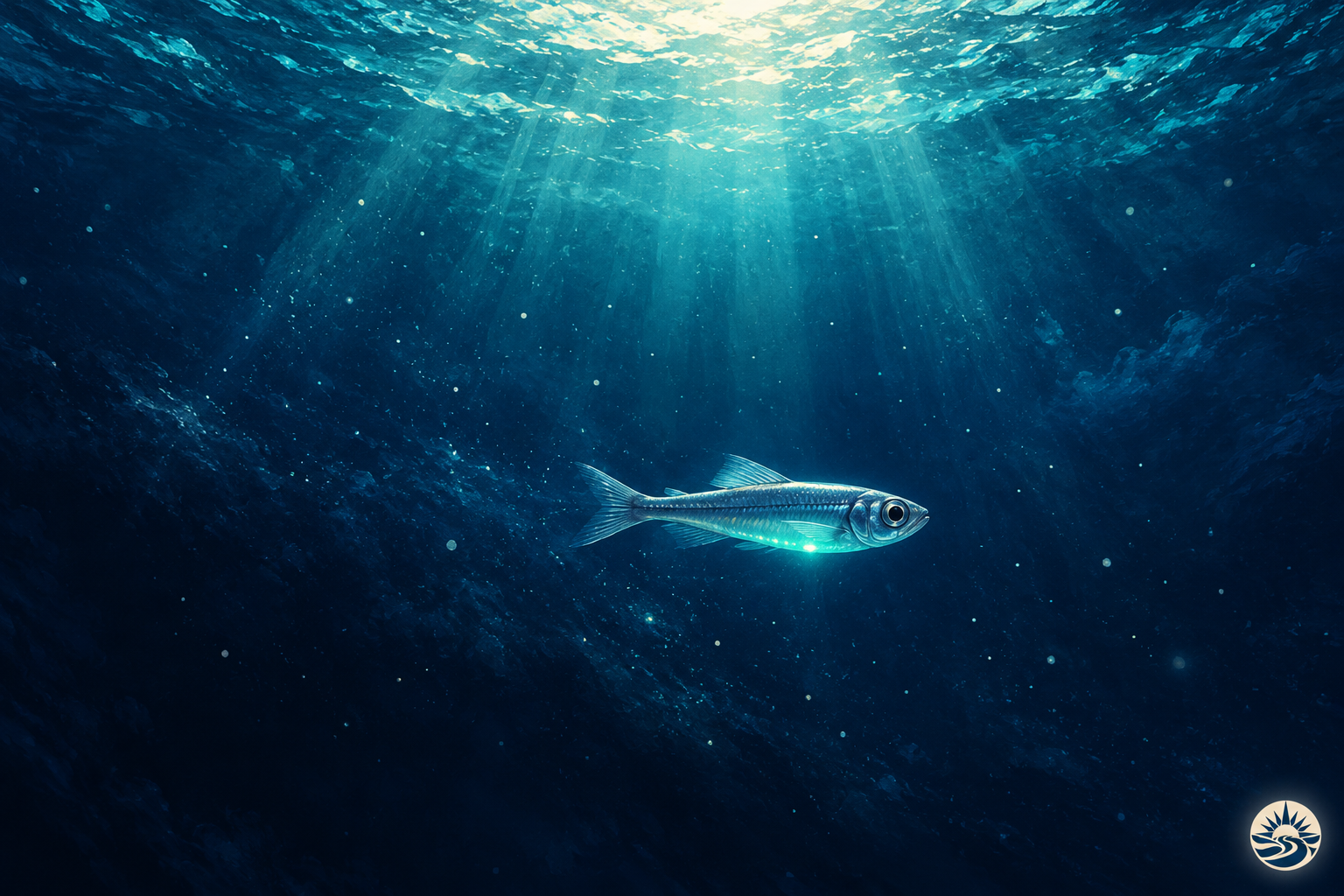
If you wanted to hide in a dark room, turning on a light would be an unusual opening move. In the ocean, it can be a very good one.
Some marine animals use light on their undersides to blend into the brightness above them. Seen from below, a dark body can interrupt the faint light coming down through the water. Producing a matching glow can make that silhouette less conspicuous. Scientists call this counterillumination. [1]
Think of it as camouflage by subtraction: remove the shadow that gives you away. The animal has not become invisible in every direction. It has made one particular view less revealing.
That is a more interesting job for a glow than simply looking spectacular in a photograph.
Bioluminescence is light generated by a chemical reaction in a living organism. It does not require an outside lamp to charge it first. Fluorescence works differently: it absorbs incoming light and re-emits some of that energy as light of another color. Both can look extraordinary, but they are not interchangeable explanations for a glowing animal. [2]
The distinction matters when we look at underwater pictures. A brightly colored animal photographed under a research vehicle's lights is not necessarily producing the brightness we see. The caption is doing scientific work, not just filling space underneath the image.
Nor does every light-producing species use its glow for the same purpose. Smithsonian Ocean describes lights that help attract prey, signals involved in mating, and defensive flashes that can distract an attacker. The deep-sea anglerfish's illuminated lure is a particularly direct proposition: dinner, this way. [1]
Many ocean glows are blue or blue-green, colors that travel well through seawater. But there are exceptions, including organisms that produce red light. The ocean's lighting department has more than one setting. [2]
It is tempting to turn all of this into one tidy explanation: animals glow to survive. True enough as a broad idea, but the details are the discovery. A lure invites attention. A defensive flash disrupts it. Counterillumination reduces a telltale contrast. Similar-looking light can solve very different problems.
The next time a luminous sea creature appears on your screen, try one question before moving on: what is this light doing, and how do we know?
Sometimes the answer is attraction. Sometimes it is defense. And sometimes the most remarkable thing about the light is what it helps you miss.
Sources & further reading
1. Smithsonian Ocean, “Bioluminescence”. Page dated September 2013, with later material incorporated; accessed October 26, 2026. Sections on protection, feeding and mating.
https://ocean.si.edu/ocean-life/fish/bioluminescence
2. NOAA Ocean Exploration, “How do living organisms produce light?”. Published May 19, 2015; updated September 29, 2020; accessed October 26, 2026.