
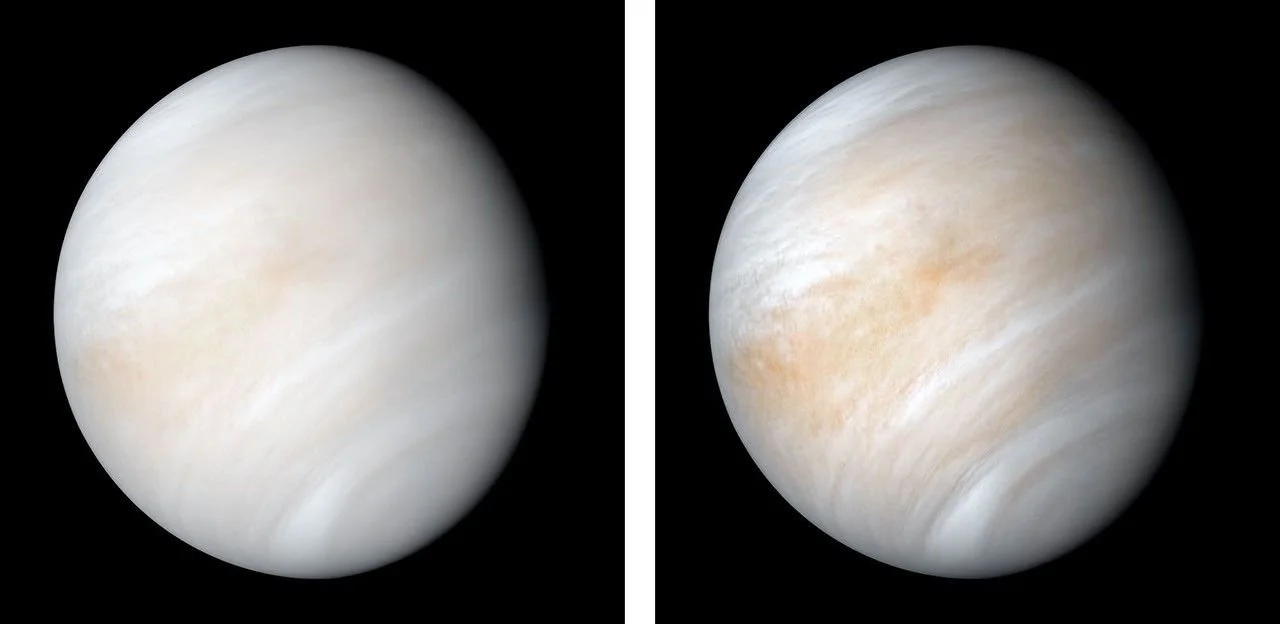
A year finishing before a day sounds like something you might say about a difficult Tuesday. On Venus, it can be a perfectly reasonable astronomical statement.
The catch is the word “day.”
A year measures one trip around the Sun. Venus completes that journey in about 225 Earth days. One full turn on its axis takes about 243 Earth days. Measured that way, Venus finishes its year before it finishes its rotation. These rounded values come from the orbital and rotation measurements in the NASA Venus Fact Sheet. [1]
So the astonishing fact is real. The version we repeat at dinner often leaves out the most interesting part.
We use “day” for more than one clock. A sidereal day measures a planet's rotation relative to distant stars. A solar day follows the Sun's apparent return to the same position in the sky, such as one noon to the next. Those are related measurements, but they are not identical. [1, 2]
Picture a mark on a spinning globe. Now imagine that the globe is also moving around a lamp. The direction from that mark toward the lamp changes as the globe travels. A full spin relative to the room need not bring the lamp back to the same place above the mark. The demonstration is only an analogy, but it makes the two moving parts easier to separate.
Venus adds another twist. It rotates in the opposite direction from Earth, a motion called retrograde rotation. Its slow spin and orbital motion combine to produce a solar day of roughly 117 Earth days, about 116.75 using the fact sheet's values. That is shorter than its year. [1, 2]
Here is the useful comparison, all measured in Earth days:
One Venus orbit: about 225. One full rotation: about 243. One solar day: about 117.
Those numbers are not competing answers to the same question. They are answers to three different questions.
The familiar claim, then, needs a small but important qualifier: a rotation day on Venus lasts longer than a Venus year. It does not mean that the interval from one sunrise to the next exceeds the year. Nor does 117 describe only the daylight half of that cycle. [1, 2]
This is part of the pleasure of an odd fact that survives a closer look. The correction does not make Venus ordinary. It reveals a planet running several clocks at once, with no obligation to keep them arranged the way ours are.
There is no need to turn that into advice about making better use of your afternoon. Venus has already supplied the entertainment.
The next time someone offers the day-longer-than-a-year fact, you can enjoy it and ask one small question: “Which day?”
Sources and Further Reading
1. NASA Goddard, David R. Williams. Venus Fact Sheet. Updated January 11, 2024. Orbital period and separate rotation/day measurements.
https://nssdc.gsfc.nasa.gov/planetary/factsheet/venusfact.html
2. Royal Belgian Institute for Space Aeronomy. Venus, backwards rotation and orbital period. Undated reference page; accessed October 22, 2026. Distinguishes sidereal and solar days.
https://aeronomy.be/en/encyclopedia/venus-backwards-rotation-and-orbital-period
